
Lahaina Community Land Trust
A 501(c)3 non-profit organization committed to protecting and perpetuating Lahaina, by empowering the Lahaina community to live, engage and prosper while protecting, restoring and caring for its ‘āina and ea.

Permanently Affordable Living Hawai‘i
A nonprofit affordable housing provider based on Kauaʻi that serves houseless and extremely-low to middle-income workforce households earning <30%-120% Area Median Income (AMI).
Website

Grounded Solutions Network
A national 501(c)3 nonprofit that promotes housing solutions that will stay affordable for generations and connects local experts with the networks, knowledge and support they need.
Website

Lincoln Institute of Land Policy
A nonprofit private operating foundation that researches and recommends creative approaches to land as a solution to economic, social, and environmental challenges.
Website

Nā Hale O Maui
A nonprofit founded in 2006 that aims to secure and preserve a permanent supply of affordable housing alternatives for low- and moderate-income households in Maui County.
Website

Kohala Community Land Trust
A 501(c)3 nonprofit that aims to provide permanently affordable rental and for-sale housing for Kohala residents, primarily by acquiring and rehabilitating the existing housing stock.
Website

Hawai‘i Housing Finance and Development Corporation
The primary agency charged with overseeing affordable housing finance and development in Hawaiʻi. Led by a nine-member board and executive director, HHFDC works with the state’s residents, housing developers and financiers.
Website

Hawai‘i HomeOwnership Center
The Mission of Hawai‘i HomeOwnership Center is to provide education, information and support to create successful first-time homeowners in Hawai‘i. By addressing barriers and increasing rates of home ownership, the HomeOwnership Center aims to build stronger families and communities throughout the state of Hawai‘i.
Website
HHOC Housing and Land Trust
A nonprofit affiliate of the Hawai‘i HomeOwnership Center with a mission to create and preserve affordable homes.
Website

HALE O Hawai‘i
A 501(c)3 founded in 2018 by a hui of community volunteers with a mission to secure and preserve a permanent supply of affordable housing alternatives for the working families of Hawaiʻi County.
Website
Updated: This story was updated on April 3, 2025 to include information from the HHOC Housing & Land Trust and HALE O Hawai‘i.
This story was co-published with Next City, a nonprofit newsroom reporting on solutions for equitable and just cities. Get Next City’s stories in your inbox.
On Aug. 8, 2024, a new milestone was reached in the aftermath of the deadly Lahaina wildfire that destroyed 2,200 structures and displaced 12,000 residents: A Lahaina nonprofit secured its first residential parcel for community ownership.
1651 Lokia Street, which once held a four-bed, three-bath house, sits empty. But one day, the property will accommodate a new main house and two ‘ohana units, providing a stable, affordable home for an extended or multigenerational family.
That property will forever remain in the hands of Lahaina’s people under the Lahaina Community Land Trust, which will own the land and only sell homes atop to kama‘āina.
Lahaina residents have long pushed back against external real estate interests and were already dealing with displacement before the fire. But amid a worsened housing shortage, rising rents and speculators looking to cash in on the tragedy, securing Lahaina and safeguarding affordable homes for its community members has become more important than ever. A March 2024 report estimated that, without intervention, as much as 20% of Lahaina’s homes could change hands in the next three years.
“I can’t even begin to quantify the impact of securing one piece of property that until forever is going to house how many people,” said Autumn Ness, executive director of the Lahaina Community Land Trust. “You can’t be evicted. How many families are going to enjoy that and be better community members for it? Because they have a roof over their head, their kids will have present parents.”
The nonprofit is one of several Hawai‘i community land trusts that have been established in recent years as ‘āina experts, community organizers, real estate professionals and others look to combat Hawai‘i’s ever-increasing housing prices, keep more longtime residents in their communities and preserve Hawai‘i’s culture and identity.
In 2023, Gov. Josh Green declared Hawai‘i’s affordable housing shortage an emergency. Hawai‘i has the highest median home sales price in the country and hasn’t been building enough homes for decades. The crisis disproportionately affects Native Hawaiians, who are overrepresented among the state’s houseless population and have a higher poverty rate than other major ethnic/race groups.
“What family in Hawai‘i is not worried about their children’s ability to be here, about their children’s ability to be close to them as they age, that they’ll be able to know their grandchildren?” said Carolyn Auweloa, chief operations officer of the Lahaina Community Land Trust.
With a high rate of out-of-state homeownership—in 2023, out-of-state buyers represented 21% of the single-family home transactions and 27% of the condo transactions—Hawai‘i’s homes are often commodified as tools to build individual wealth. The local community land trusts hope to change the narrative around housing in paradise by emphasizing collective, rather than individual, wellbeing.
That means embracing that stable, affordable housing can strengthen families and communities when residents don’t have to work two or three jobs to get by.
“The big paradigm shift that we try to bring people across is to stop thinking about real estate as a wealth-building vehicle and see it instead as a community asset,” Auweloa said. “It doesn’t matter how much housing we create, there will always be this insatiable demand for it because it’s so desirable to be here.”
It reinforces this idea that housing is just not about this singular commodity. It’s about the community wealth. It’s about the stability. It’s about our cultural resilience. It just gives us more control as a community.
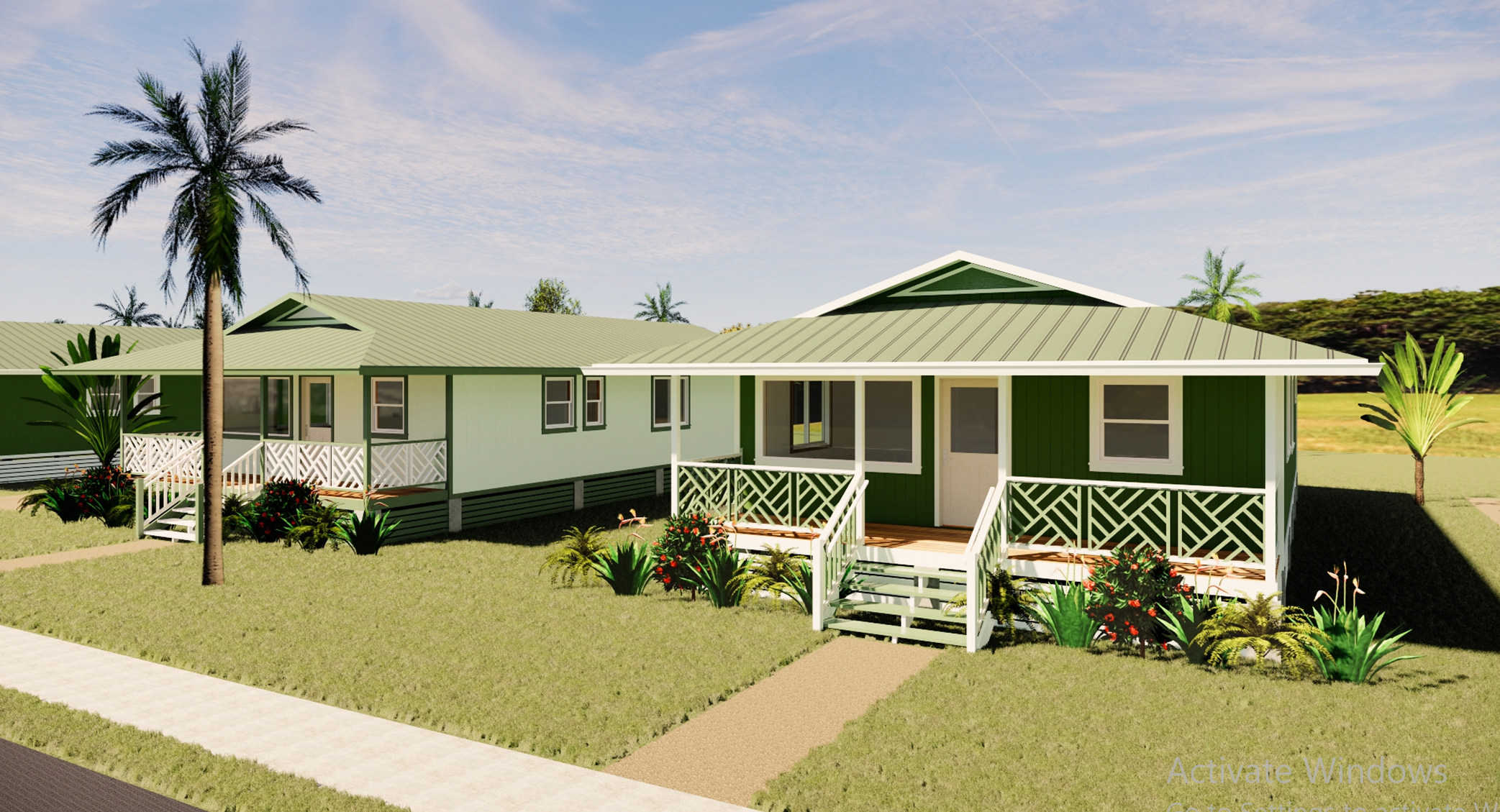
Kaua‘i nonprofit Permanently Affordable Living Hawai‘i has so far placed five under-construction homes in its Kauhale O Namahana project in Kīlauea into its Ho‘omaluhia Community Land Trust. The project, which comprises 2- to 5-bedroom homes, will serve households earning 120% of the area median income and below, and homebuyers will be chosen from Kaua‘i County’s First-Time Homebuyer list. A 2-bedroom home is expected to sell for about $417,000, while a 5-bedroom home will be nearly $540,000. | Courtesy: PAL Hawai‘i
A Form of Collective Stewardship
Community land trusts are one form of collective stewardship. Hawai‘i knows that model well, given that all land once belonged to the highest-ranking chief and was collectively cared for by maka‘āinana, or commoners.
After the Great Māhele of 1848 began implementing private landownership, some Native Hawaiians and other Kingdom of Hawai‘i citizens formed land huis to collectively purchase and steward land. In 1869, a hui of 71 Native Hawaiians and other Kingdom citizens purchased almost the entire 15,000-acre ahupua‘a of Wainiha on Kaua‘i, according to a 2012 article in the University of Hawai‘i Law Review. Six years later, 38 Native Hawaiian Hā‘ena families jointly purchased the neighboring ahupua‘a of Hā‘ena.
“The community land trust and the hui are just two examples of how our society has grappled with this broken system that has never really worked—of private property ownership and that private property ownership equals the right for someone to use property to build their individual wealth,” Ness said.
Community land trusts are powerful mechanisms for preventing communities of color from being displaced. The first community land trust in the U.S. originated in the southern U.S. Civil Rights Movement in the late 1960s to create a new form of land tenure for Black farmers.
Community land trusts are nonprofits that own land on behalf of a place-based community and sell or rent the homes on top. They are generally governed by a board of land trust residents, broader community residents and public representatives.
They make their land available to homeowners through renewable ground leases that typically last 99 years. By owning the land and limiting the price at which homes can be sold for, they make the cost of homeownership more accessible to a wider segment of the community, including those with limited means, and protect the properties from speculation.
There are 314 community land trusts across 46 states, D.C. and Puerto Rico, according to a 2022 census by the Lincoln Institute of Land Policy, a nonprofit think tank, and the Grounded Solutions Network, a national nonprofit that advances permanently affordable housing solutions. These community land trusts hold nearly 44,000 permanently affordable housing units.
Jason Webb helps community groups around the country start community land trusts as a community and technical assistance principal at the Grounded Solutions Network. He said community land trusts are a growing model that tends to follow hot real estate markets where lower-income individuals have been priced out. More community land trusts are also being created in Indigenous communities and in the wake of natural disasters.
And whereas many of the country’s earlier land trusts were started by community activists and organizers, he’s now seeing many be started by professionals, such as those working in real estate, business and foundations.
Taylor Kaluahine Lani, chief operating officer and co-founder of Kaua‘i nonprofit Permanently Affordable Living Hawai‘i, said community land trusts are a culturally competent model for homeownership in Hawai‘i because they redefine wealth as family and community wellbeing.
Lani grew up on the island’s North Shore and became a real estate agent upon returning after college. Locals, she said, tend to stay in place once they’ve found their piece of property, building additions if they need more space, and embrace having a long-term home base where their families can have security. That’s a different mentality than using their homes to move to different neighborhoods, counties or even out of Hawai‘i to climb the economic ladder.
“We still can build wealth without contributing to that displacement,” Lani said. PAL Hawai‘i launched its Ho‘omaluhia Community Land Trust in 2024 and has so far placed five homes under construction in its Kauhale O Namahana project into that trust. The Kīlauea project will eventually contain 11 homes. PAL is also building projects in Kalāheo and Waipouli.
Hawai‘i’s Community Land Trusts
- HHOC Housing & Land Trust (nonprofit affiliate of O‘ahu-based Hawai‘i HomeOwnership Center)
- Ho‘omaluhia Community Land Trust (under Kaua‘i-based Permanently Affordable Living Hawai‘i)
- Kohala Community Land Trust
- Lahaina Community Land Trust
- Nā Hale O Maui
- HALE O Hawai‘i

Jen, Kūmoanaākea, Richard and Keolaonākai’elua Mather at the key presentation for their new Wailuku home last year. Nā Hale O Maui has sold 50 single-family, leasehold homes to 57 families since it was founded in 2006. | Rylee Sparling, KSM 2026 for Nā Hale O Maui
Permanently Affordable Housing
Carrie DeMott was teaching in West Maui when she heard about the Nā Hale O Maui community land trust from a fellow educator. She was renting and decided to go through its four-step qualification process because she felt she “needed to be doing something towards getting stable housing” for her young son.
About seven years ago, sewage from her shower overflowed throughout her rental. Seeing her son trying to pick up a sewage-covered book he had been gifted from his nana was a wake-up call.
“I scooped him up, and I was just like, what? Oh, my God. Like, how am I here?” she said. “I did everything right. I went to college. I paid off my loans. I’m working as a teacher. I’m giving my heart and soul to the community, and here I am, and I’m in this horrible house, and my kid’s books are covered in sewage.”
She was ecstatic when she was selected to purchase a home from Nā Hale O Maui and went on to serve as a resident member of the organization’s board to help be a voice for homeowners. She’s now the nonprofit’s interim executive director.
Founded in 2006, Nā Hale O Maui is the longest-running community land trust in the state and has 50 homes in its trust. Dave Ward, a founding member and current board member, said the community land trust stemmed from a diverse group of individuals—including real estate professionals, an attorney, a county council member, a planning commission member and others—who wanted to address the island’s growing housing affordability gap.
The Great Recession began shortly after the organization was formed, so its early years were spent acquiring and rehabilitating empty, foreclosed homes. It’s continued to buy existing homes, in addition to building on empty lots. A few of those already-built homes were donated in-kind from the county, and the county has also donated lots for the land trust to build on.
Nā Hale O Maui has sold leasehold homes in Kīhei, Kahului, Wailuku, Lahaina and Makawao at below-market prices, and, like many land trusts, its resale prices are determined using a formula to preserve affordability for low- to moderate-income households in perpetuity.
That formula considers the initial purchase price, the homeowner’s share of appreciation, any capital improvements that the homeowner did, and whether the home has suffered excessive damage or neglect. The homeowner’s share of appreciation ranges from 25% to 50%, depending on how long the homeowner stayed in the home.
“It’s like if you were going to invest money in a money market, maybe a high-yield savings account, or something like that,” DeMott said. “You’re not going to pop out of this with a windfall.”
DeMott and Ward acknowledge that this model is not for everyone, but it has helped two families move into market-rate homes.
According to Webb, homeowners stay in a community land trust home for an average of 10 years, though many organizations encourage homeowners to stay longer, even for several generations.
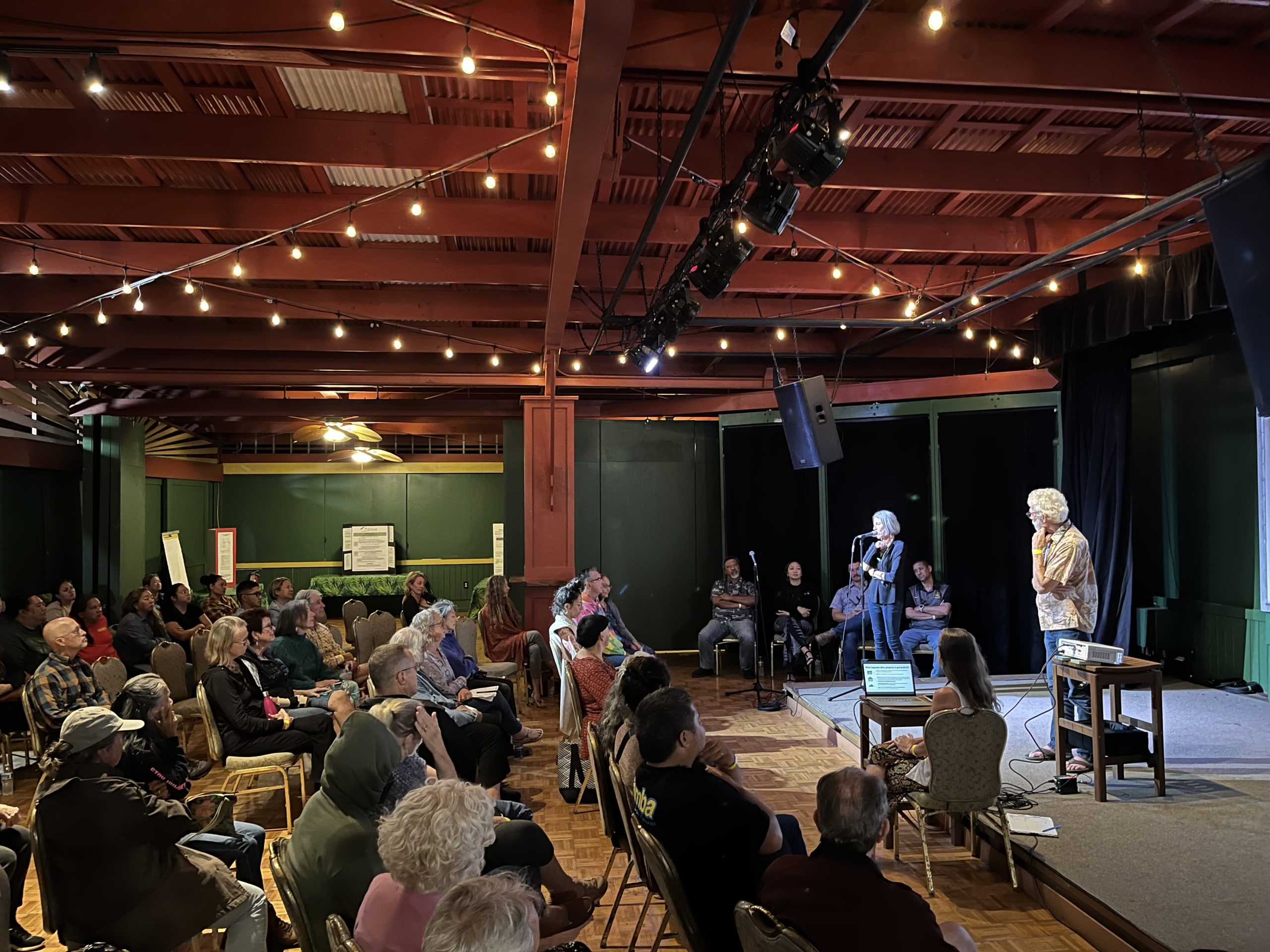
The Kohala Community Land Trust’s first annual membership meeting in January drew a full house. The nonprofit is focused on acquiring plantation-era Kohala homes. | Rascha Jelks for Kohala Community Land Trust
It’s About the People of a Place
In the northwestern corner of Hawai‘i Island, Kohala is renowned for being the birthplace of King Kamehameha I and a training center for his army. It’s also famous for its plantation roots, which brought in the Filipino, Japanese, Chinese and Portuguese families that, along with Native Hawaiians, have long made up the community.
Ashton Dircks is a seventh-generation taro farmer, former archaeologist and current high school teacher who was raised in Kohala. He recalls the days when everyone knew each other and how he couldn’t go down the road without waving at almost every car. That wasn’t the case when he returned home about eight years ago.
“I didn’t recognize any of the cars on the road or the people driving those cars,” he said. “I go to the post office, and I felt like I was a minority in the town I grew up in.”
Now the chair of the Kohala Community Land Trust’s board, he hopes to give Kohala residents a chance to stay and thrive in the community.
“It’s the people who make the place, and without those people who are Kohala, Kohala is just not the same,” Dircks said. “And this land trust, I saw this as a vehicle to try to get Kohala people back.”
Kohala residents had been searching for a community-led housing solution since 2000. The Kohala Community Land Trust was originally formed in 2003, but a lack of funding caused it to dissolve in 2006. The land trust’s current iteration was born in 2023 from conversations among the 2008 North Kohala Community Development Plan’s affordable housing group.
Kohala has seen limited affordable housing development. One challenge is that most of Kohala is zoned for agriculture and requires that building sites be at least 20 acres, said Beth Robinson, board secretary of the Kohala Community Land Trust and one of eight North Kohala residents who helped revitalize the nonprofit.
Community Land Trusts on the Rise in the U.S.
In 2011, there were 242 community land trusts in the U.S. In 2022, that number grew to 314.
–Lincoln Institute of Land Policy
The organization hopes to acquire plantation-era homes on smaller lots of about 10,000 or 15,000 square feet, rather than building new ones. Robinson, who is also a real estate broker and director of conservation and legacy lands at Hawai‘i Life, said that of the 203 homes sold for under $400,000 between 2009 and 2024, 73% went to Kohala or nearby residents and 27% went to outsiders.
“While it wasn’t as bad as we all thought, because we’re saying that almost three-quarters of the homes did not go to outsiders, 55 homes did,” Robinson said. “So that’s where we kind of came up with this model of every home that we don’t lose to an outsider is a home that we don’t have to build.”
The land trust received its 501(c)3 status in August. It spent the fall getting input from community groups and held its first annual membership meeting in January. Its committees are now helping the trust determine what properties to acquire and what policies it should follow, and it hopes to secure its first property by the end of 2025.

1651 Lokia Street will forever remain in the hands of Lahaina’s people under the Lahaina Community Land Trust, which will own the land and only sell homes atop to Lahaina residents. | Courtesy: Lahaina Community Land Trust
Born in the Aftermath of a Disaster
The Lahaina Community Land Trust aims to purchase destroyed parcels from Lahaina residents who don’t want to rebuild but still want to see the land remain with the community.
“What the community land trust solution offers is a big ‘and,’ ” Auweloa said. “They can get what they need to move on, if that’s their choice, if that’s what they need to do. And they can commit their land in a way that is good for the future and is good for the community, and it can even include them in the future.”
Auweloa grew up in Lahaina and spent 22 years working with the U.S. Department of Agriculture. Much of those years were spent on Hawai‘i Island, where she would work on conservation and agricultural easements.
“It was that perspective and that experience that inspired, in the wake of the fire and the fear of the land grabs, that there must be some way that we could put some kind of protection on land that would preserve it for a community, for people,” she said.
Lahaina was once the capital of the Hawaiian Kingdom. It became a global whaling and trading center before transitioning into a quiet sugar plantation town and then a major tourist destination. As a result, Lahaina residents were already seeing their community transform long before the 2023 fires as more and more newcomers, especially wealthy retirees, moved in and working-class residents moved out.
Auweloa said it was important to the organization’s founders that its executive and advisory boards be intentionally composed of individuals with deep Lahaina roots, given Hawai‘i’s history of stolen lands and unmet promises to provide affordable housing. Many are ‘āina experts—individuals who have long histories of protecting water, ‘āina and Hawaiian culture.
“We’re intentionally different,” she said. But she noted that she is seeing more community members who used housing for wealth generation understand that it’s about family and community wellbeing.
The sellers of the Lahaina Community Land Trust’s first acquisition, for example, returned to the continent and sold their property to the land trust because they didn’t want to contribute to the further displacement of Native Hawaiians and exploitation of Hawai‘i’s lands by outside interests.
The trust has so far secured five parcels and is looking at 12 others. In addition to acquiring land, it also plans to use perpetual “kama‘āina easements” to require that properties it assists in other ways be sold only to Lahaina residents if they change hands. And the land trust will be offered the property first.
The kama‘āina easements will be used for the organization’s insurance gap pilot program, which will help Lahaina residents rebuild their homes. Ness, the organization’s executive director, estimated that the average gap for underinsured residents is about $400,000.
Ness previously worked in housing policy and said that Maui County’s average per-unit subsidy over the last decade was about $350,000. But because those homes only stay affordable for five to 10 years, they only help one homeowner. In comparison, the land trust’s investment of $400,000 will result in a permanently affordable home.
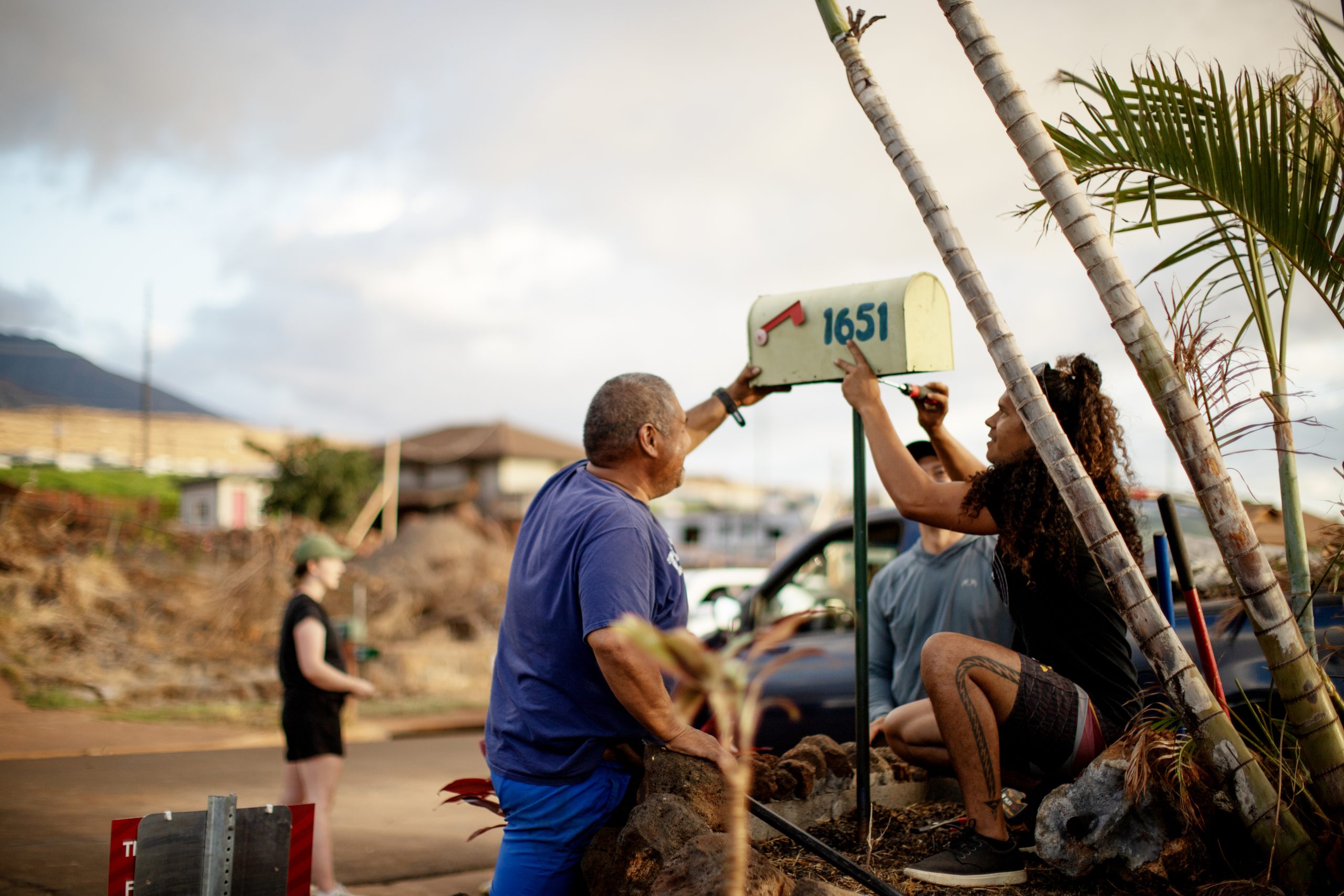
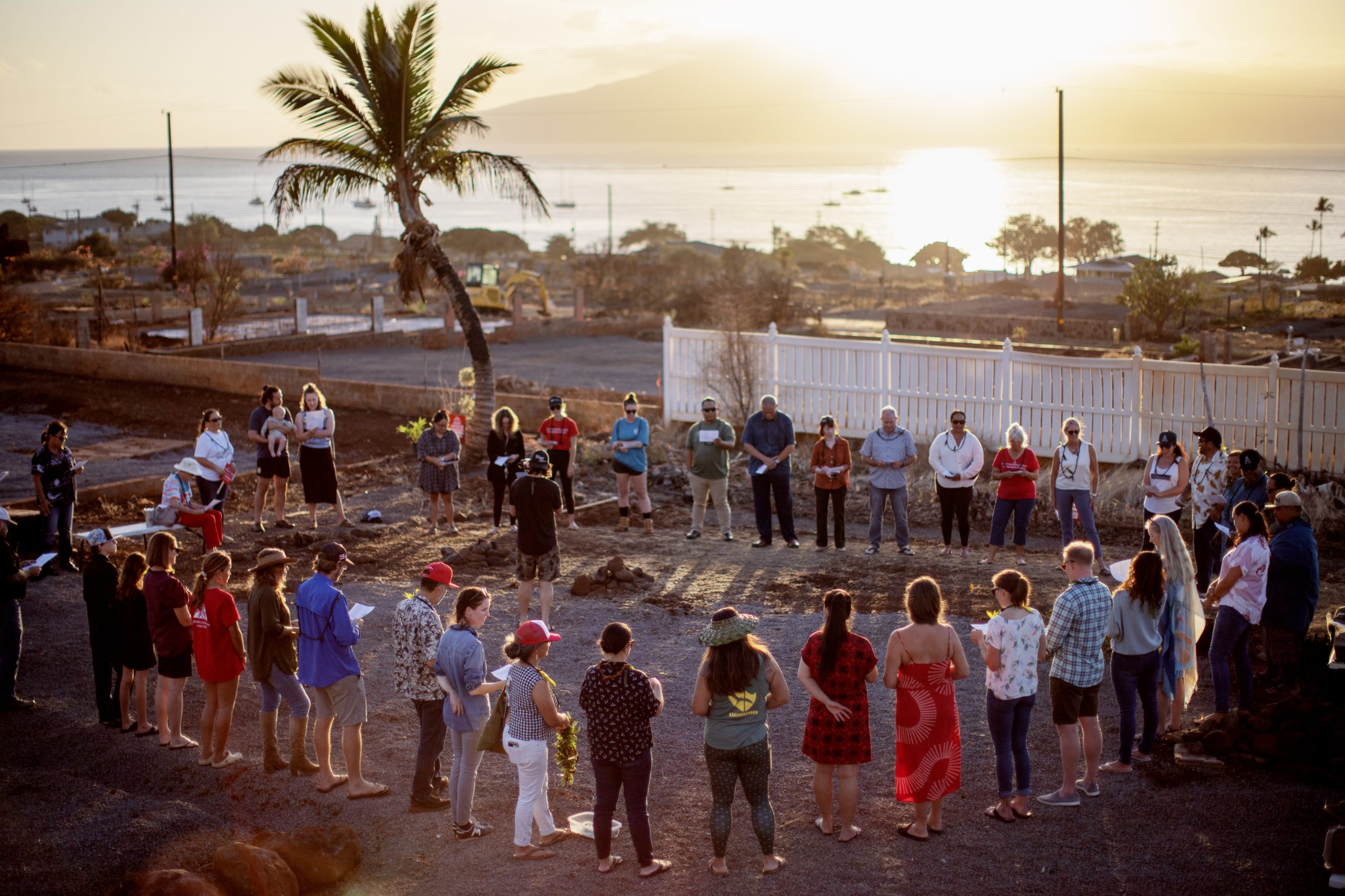
Staff, family and friends of the Lahaina Community Land Trust participate in a workday at 1651 Lokia Street, the first parcel the trust acquired for community ownership. | Courtesy: Lahaina Community Land Trust
Selling Affordable Homes on O‘ahu and Hawai‘i Island
The Hawai‘i HomeOwnership Center (HHOC) provides education and information to help residents become first-time homeowners. It created its nonprofit affiliate, HHOC Housing & Land Trust, to help create and preserve affordable homes.
The original intent was for the community land trust to buy affordable homes that have resale or buy-back restriction periods under local government agencies, said Reina Miyamoto, executive director of HHOC. HHOC Housing & Land Trust is the buyback agent for the Hawai‘i Community Development Authority (HCDA), but it hasn’t acquired HCDA units yet.
Miyamoto said the community land trust has so far purchased eight homes on the open market and then subsidized the resale costs to keep the prices affordable to first-time homebuyers with household incomes up to 120% of the area median income.
For example, its first home was a two-bedroom condo in the Waipahu Plantation Town Apartments, which it acquired for $298,000. After renovations, the community land trust sold it in 2019 for $285,000. Miyamoto said it makes a difference when the organization can acquire properties at discounted prices or receives cash donations to help it offset expenses.
Pete Hoffmann, board president and co-founder of HALE O Hawai‘i, echoed a similar statement. It’s much more cost-effective on Hawai‘i Island to build new homes on empty lots instead of buying and reselling existing homes.
The community land trust, which was created in 2018, targets households with incomes between 60% and 140% AMI. Many don’t have the ability to qualify for a mortgage for a home over $400,000, so the goal is to find land as affordably as it can and then sell a newly built home at-cost.
HALE O Hawai‘i is also exploring the potential of sub-leasing lots from the state and county in existing developments, which would lower the amount of funds it spends on land.
“I’m open to any reasonable strategy that would allow us to get land that we can put a home on,” Hoffmann said.
Expanding Hawai‘i’s Community Land Trusts
There are six active community land trusts in Hawai‘i. State Rep. Tina Nakada Grandinetti said with Hawai‘i experiencing so much displacement, many residents are hungry for a sense of control over what happens to their homes and neighborhoods.
This legislative session, she introduced two bills that aim to encourage the expansion of community land trusts and prevent the loss of foreclosed homes to second homebuyers and residential investors.
HB 833 would create a five-year pilot program under the Hawai‘i Housing Finance and Development Corporation to provide community land trusts with a line of credit to help them provide affordable homes. And HB 467 would prohibit sellers of foreclosed homes from bundling properties at a public sale and allow community land trusts 45 days to match or beat the best public sale bid to buy the property. HB 467 is dead for this session, but its Senate Companion, SB 332, is still moving forward.
In the meantime, Nā Hale O Maui has sold homes to 57 families—directly impacting well over 100 children. DeMott said she knows quite a few teachers who are still teaching on Maui because of the organization, and the most recent families included police officers and firefighters.
“It keeps the people that do community service-based work here,” she said. And the organization’s homebuyer education has helped many families become more knowledgeable about affordable housing and what resources are available.
In Lahaina, the Lahaina Community Land Trust is developing a weighted lottery system that it’ll use to choose homeowners for its homes. The plan is to prioritize Lahaina community members based on how long they lived in the town, to ensure the homes go to those with deep ties to the community. Maui County already allows for workforce housing applicants—both for ownership and rental units— to be selected by lottery and then be ranked by the total length of time each has been a resident of the County.
“We can actually make a system that favors our community, so hopefully it’ll normalize the conversation a little bit as we do it,” Ness said.
She and Auweloa said every property that the Lahaina Community Land Trust finds a solution for is a win that they are proud of. The land trust’s goal is to protect 20% of Lahaina’s homes.
“I’d written off ever being able to live here,” Auweloa said. “… I’m stoked that we’re starting something here that’s only going to gain momentum and is going to mean a new outcome for many families for Lahaina.”