
E Ola Kākou Hawai‘i
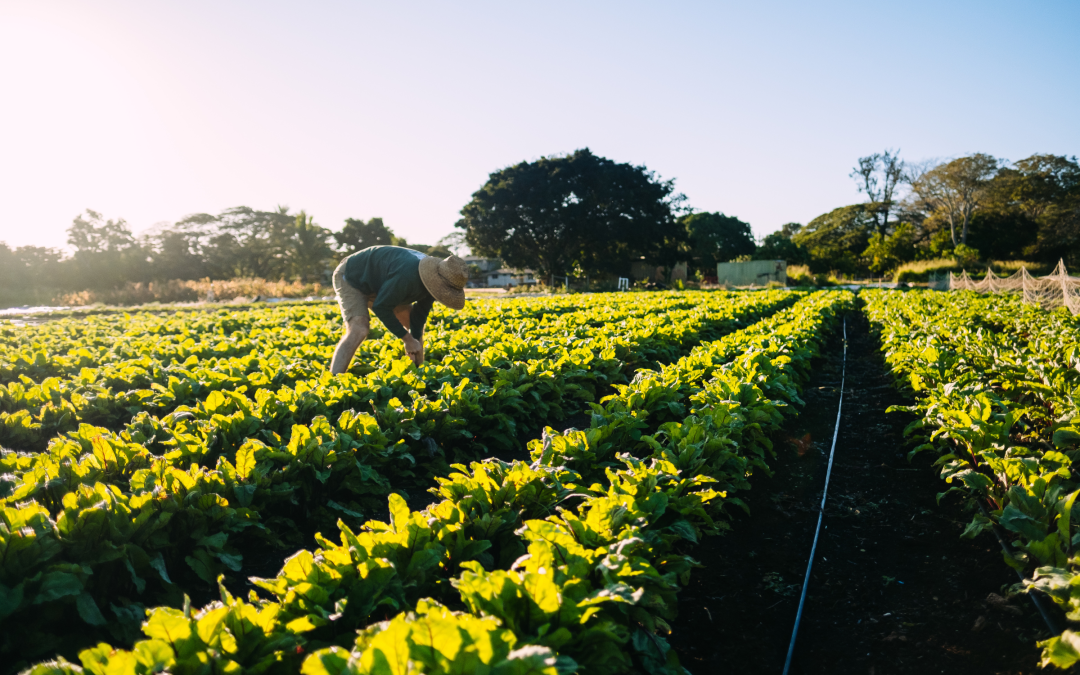
A nonprofit formed in 2021 that has been organizing community workdays to find and eradicate Coconut Rhinoceros Beetles in breeding sites.
CRB Response
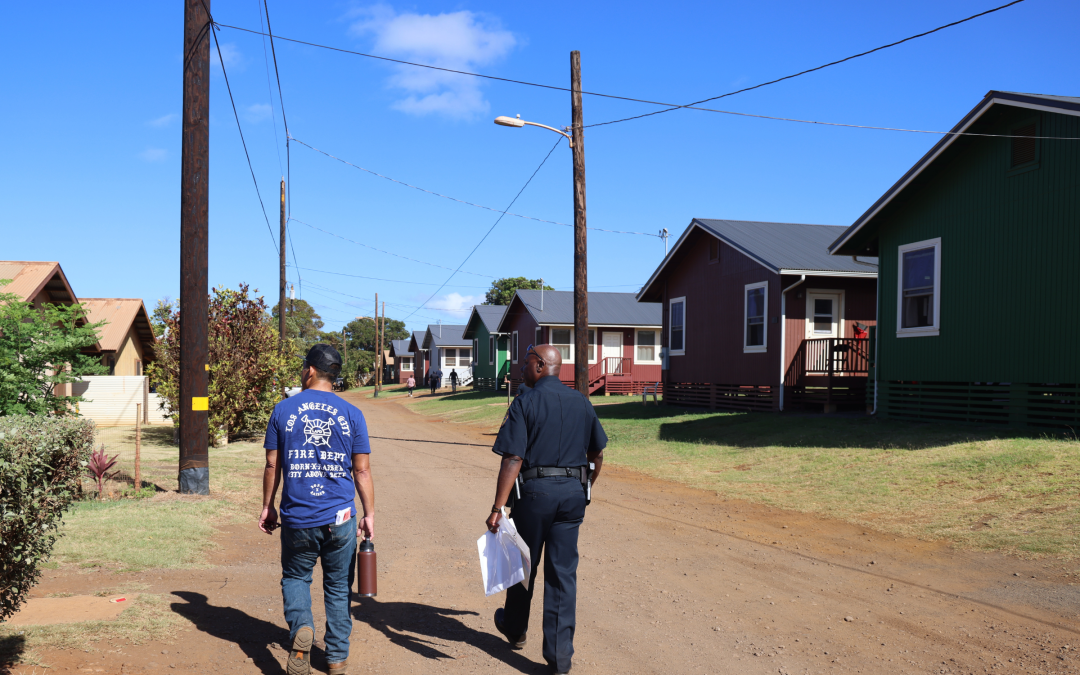
A grant-funded organization managed through the University of Hawai‘i that provides education, awareness, detection, prevention and treatments to protect Hawai‘i from the threats and impacts of CRB.

Kaua‘i Invasive Species Committee
A project of the University of Hawaiʻi’s Pacific Cooperative Studies Unit that works to prevent, control or eliminate the most threatening invasive plant and animal species.

Kaua‘i Nursery & Landscaping
A full-service nursery and licensed landscape company operating on about 150 acres in Līhu‘e.

Kaleo's Tree Services
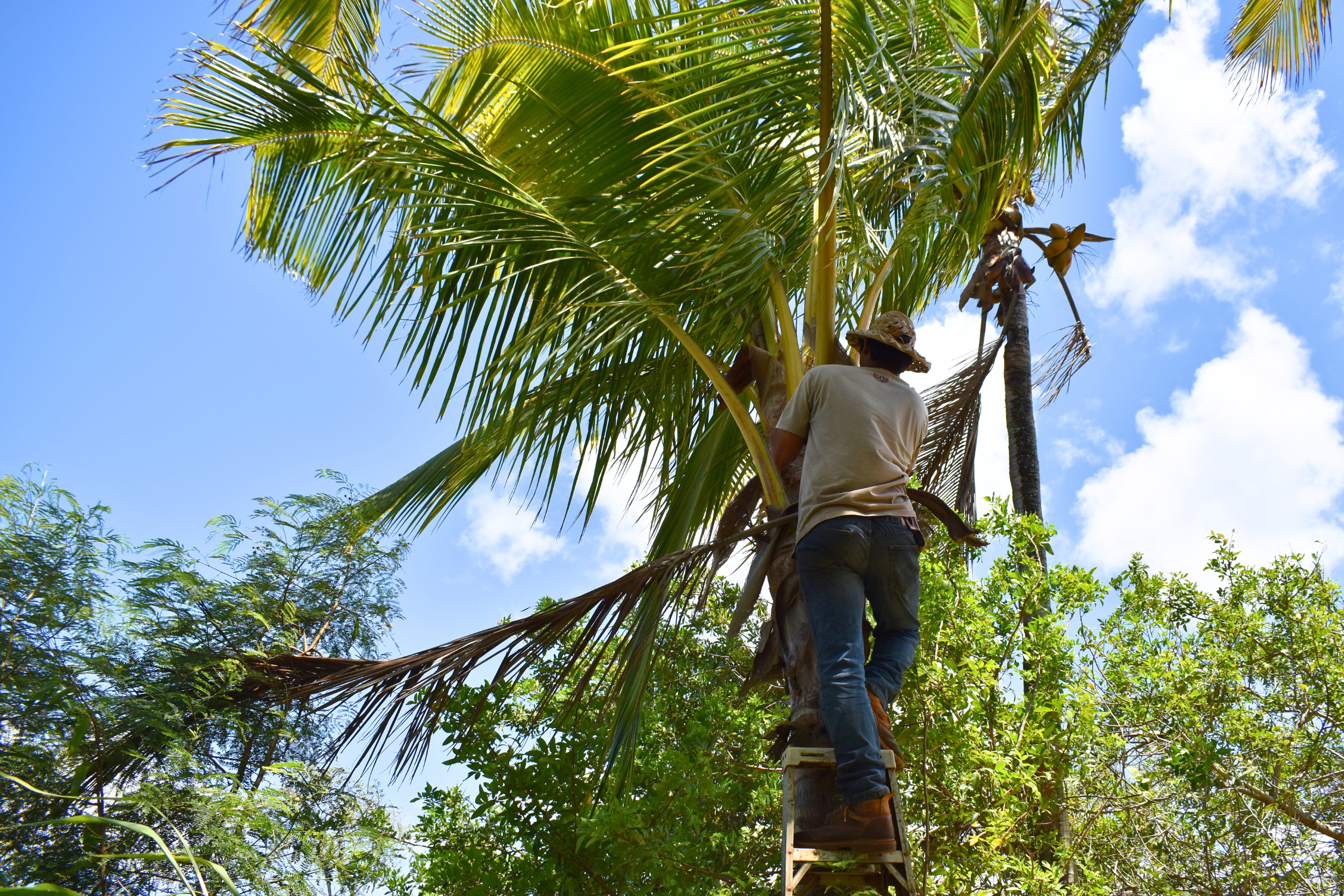
A full service tree trimming and excavation company owned by Kaleo Chandler.

Mālama Kaua‘i
Founded in 2006, Mālama Kaua’i is a community-based, 501(c)3 nonprofit organization that focuses on increasing local food production and access for Kaua‘i.
Garden Island Resource, Conservation & Development
An independent, nonprofit, nonpartisan, community-based organization focused on the prudent use of natural and human resources on the Island of Kaua‘i.

‘Āina Ho‘okupu o Kīlauea
A nonprofit that aims to facilitate solutions to economic, social and agricultural/food security challenges that the Kīlauea community and Kaua‘i faces.

Conservation Dogs of Hawai‘i
A nonprofit that facilitates the research and use of ecological detection dogs in the Hawaiian archipelago. Over the years, the nonprofit has trained dogs to detect devil weed, yellow crazy ants, rodents, little fire ants and endangered seabird nests.
Palm fronds sway as trade winds blow from Kaua‘i’s northeast, with the only other sound being an occasional car driving down the nearby road. There’s about four dozen coconut trees ahead and, at a distance, they look ordinary with their full, green leaves and impressive heights. But step closer and it’s evident they’ve been targeted by the Coconut Rhinoceros Beetle (CRB).
Many of the trees have two-inch bore holes at the bottom of their crowns. The horned, black beetles have burrowed into the trunks to eat developing leaves, as well as sap in the tree’s inner core. If the beetles do enough damage, they can severely weaken and kill the trees.
The farmer I’m with estimates that beetles have damaged 60% to 80% of his adult coconut trees—and they’ve started to eat a couple of his banana trees.
It’s just one example of how the invasive beetle has impacted Kaua‘i in the two years since it was first found on the island. Initial responses focused on eradication, but with sightings now occurring between Kekaha and Hanalei, Kaua‘i has shifted its attention to containment, according to Hawai‘i’s statewide CRB communications plan.
Various community groups, individuals and businesses are stepping up to help by organizing workdays and changing their own practices, but those involved emphasize that it’ll take collective, community-wide involvement and more government and political support to successfully eradicate the beetle.
“We don’t want the next generations to be accustomed to CRB,” said Manawaiakea Cummings, po‘o (board president) of E Ola Kākou Hawai‘i, a nonprofit that has been mobilizing Kaua‘i community members to search CRB breeding sites.
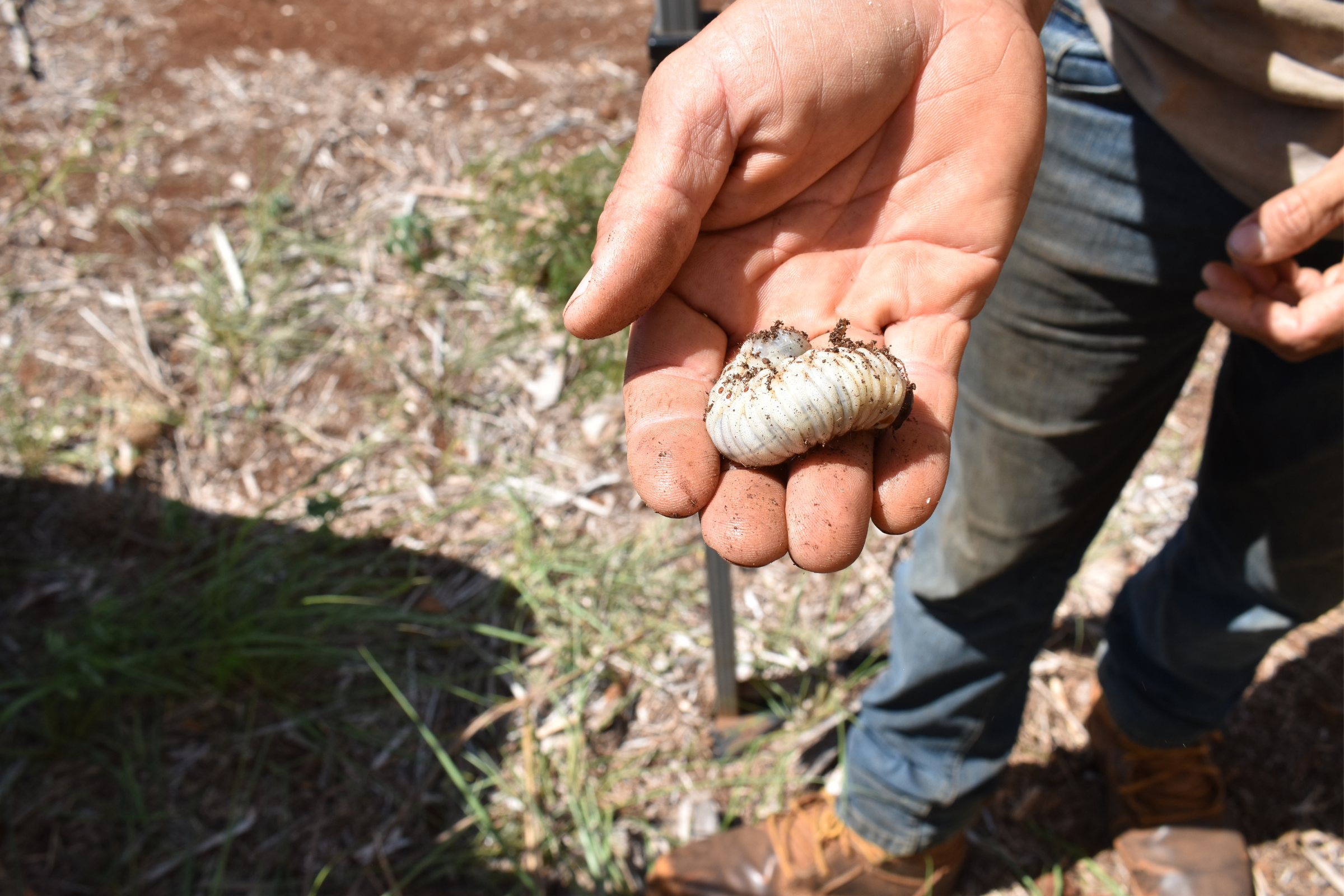
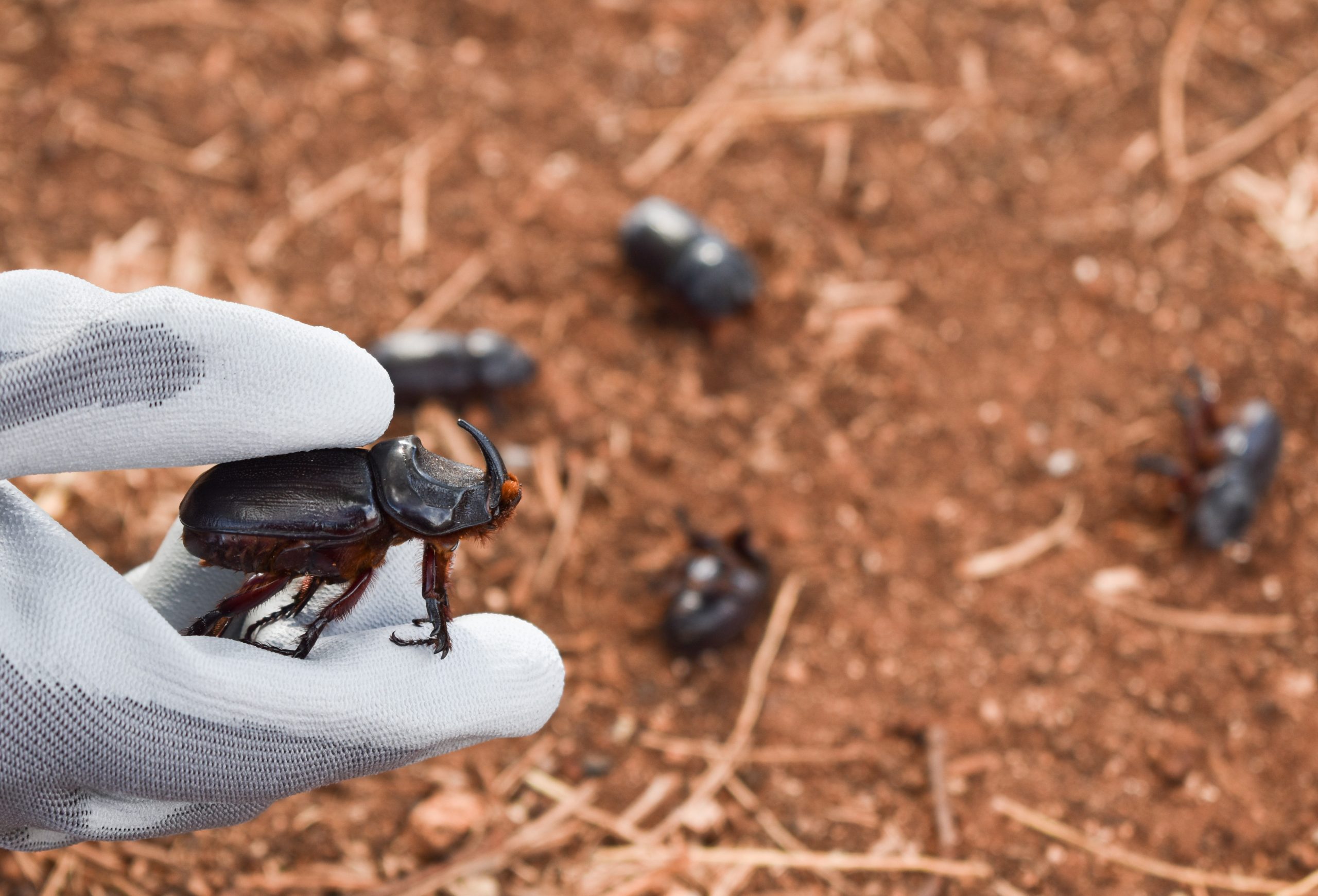
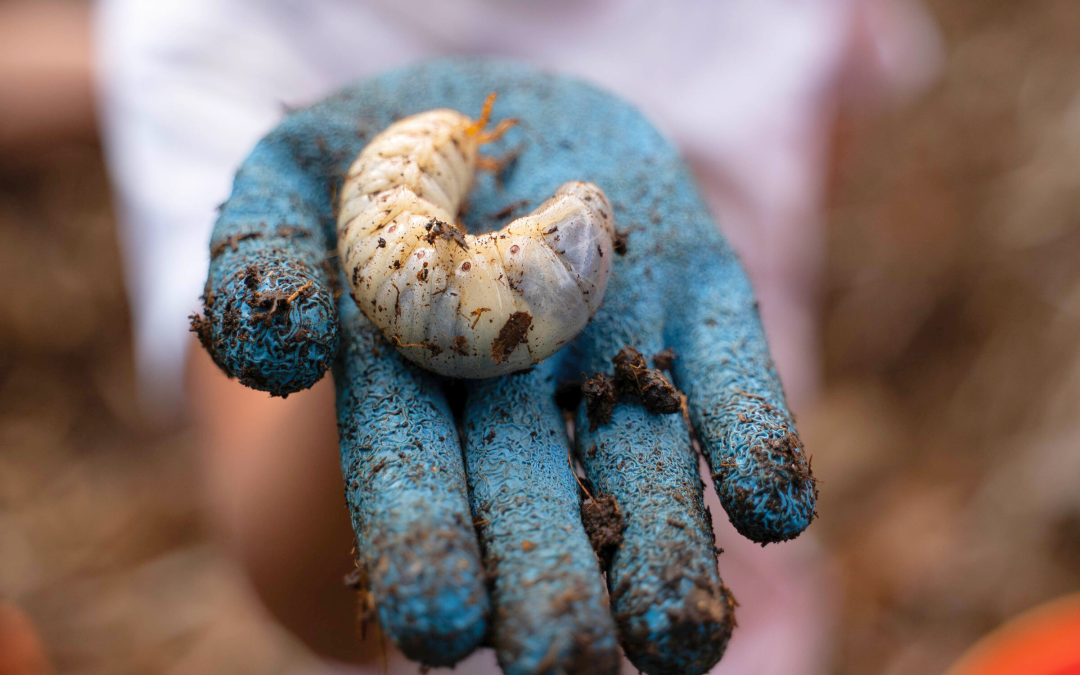
Originally from Southeast Asia, CRB spend about 5.5 months living and eating in decomposing plant material, which serve as breeding sites. They then feed from trees as adults, and adults often switch the palms they feed on. | Larvae photo: Noelle Fujii-Oride, Overstory | Adult beetle photo courtesy: CRB Response
‘A Perfect Breeding Ground for CRB’
CRB has been in Hawai‘i since 2013, when they were discovered at a golf course at Joint Base Pearl Harbor-Hickam. Kaua‘i was the first neighbor island to report a detection in May 2023.
The first beetles were discovered near the Līhu‘e airport, but breeding sites were soon found in Puhi, Wailua and Kīlauea, said Keith Weiser, deputy incident commander for the O‘ahu-based CRB Response, which sent survey teams to the island in 2023.
Since then, CRB have been detected around Kaua‘i, most likely through human-vectored movement of infested materials. The Kaua‘i Invasive Species Committee (KISC) has a network of 191 CRB detection traps deployed, and 115 of the traps have detected the beetle, wrote Tiffani Keanini, KISC manager, and Haylin Chock, KISC outreach specialist, in an email.
Most detections have been in coastal areas, but KISC is starting to see CRB damage further inland, like in the Wailua Homesteads. Not all detections mean that beetles are breeding in those areas, but unmanaged and untreated green waste combined with high concentrations of palm trees put areas at higher risk for CRB infestation.
“Kaua‘i’s landscape is essentially a perfect breeding ground for CRB,” wrote Keanini and Chock. “We have a lot less urbanized areas as compared to O‘ahu and many large green spaces with decaying matter that can serve as potential breeding sites as long as feeding material is available nearby.”
Wailua, Līhu‘e and the south side have had a higher density of beetle detections, with the largest breeding site that KISC is aware of in the Wailua coastal area. KISC doesn’t have any CRB-dedicated funding, so it’s role has been limited to getting out information and sharing best management practices.
An infestation at the county-owned Wailua Municipal Golf Course led to Kaua‘i’s Department of Parks & Recreation and the Hawai‘i Department of Agriculture (HDOA) doing drone-based pesticide treatment trials in 2023.
Pat Porter, director of Kaua‘i’s parks department, wrote in an email that golf course staff, with HDOA’s guidance, have since used a systemic pesticide that’s injected into the trunk of every coconut tree on the course. A second round of applications was completed the week of May 19.
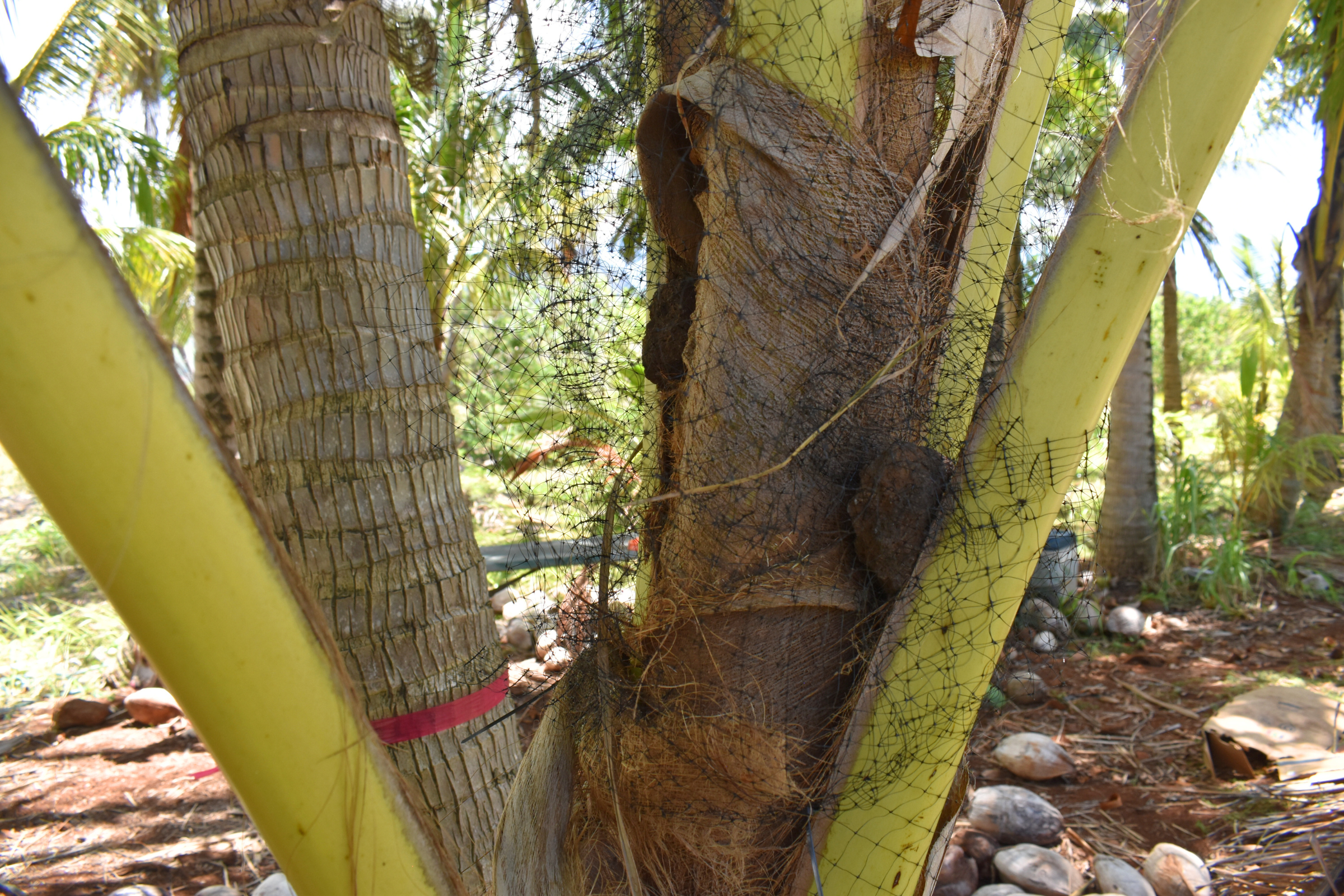
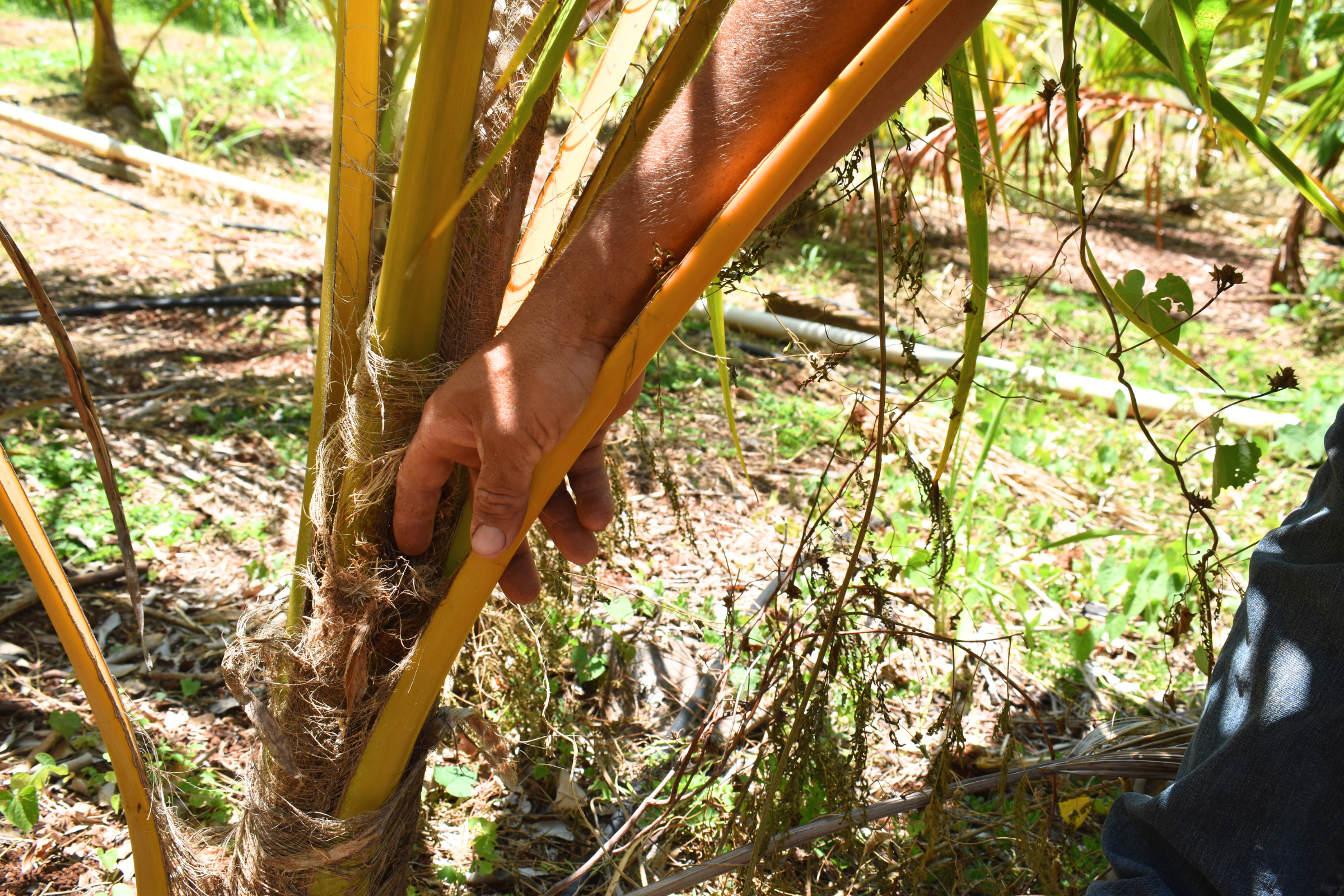
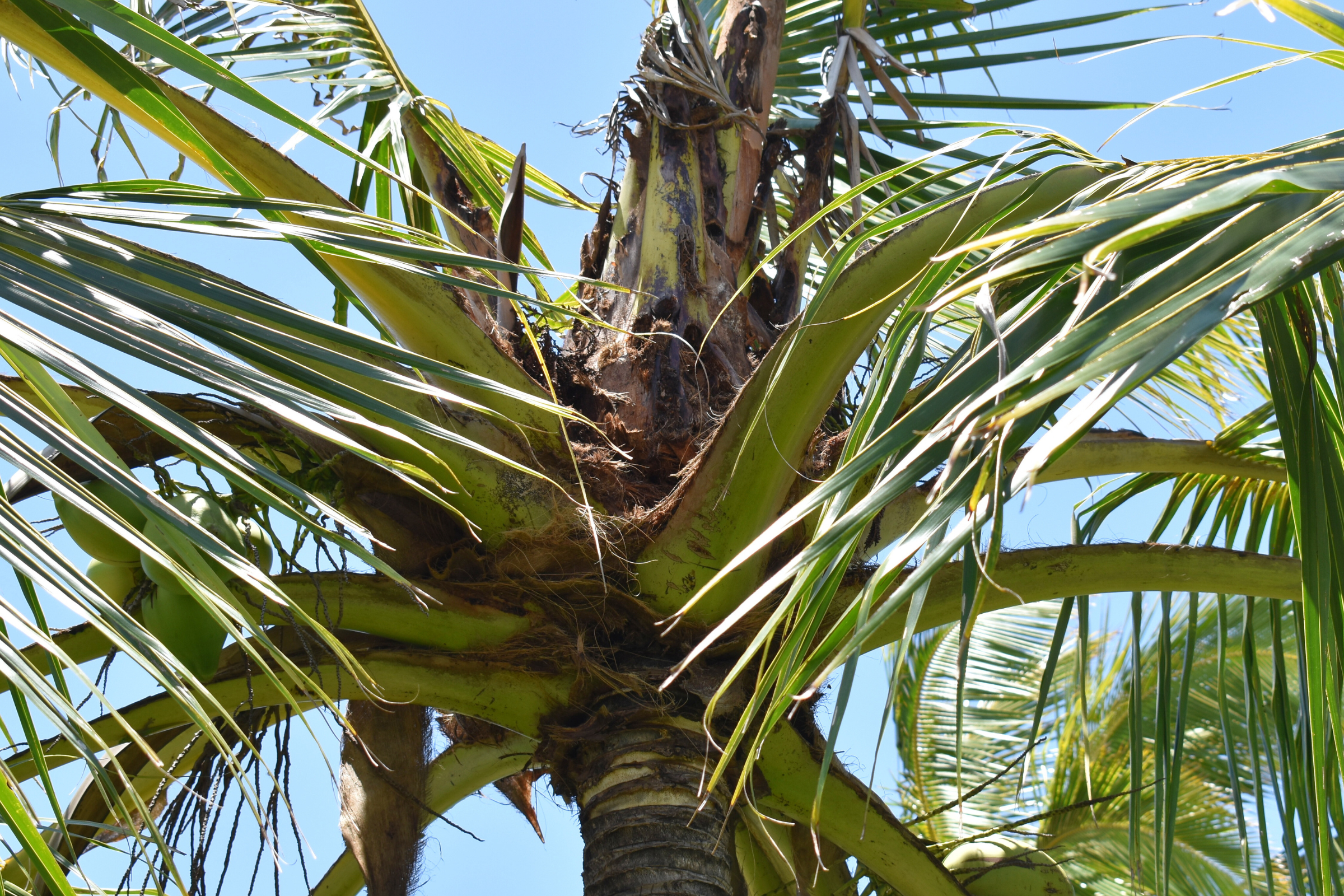
CRB use their horns and front legs to bore into the crowns of trees, leaving two-inch bore holes. Some community members protect young or short palm trees by wrapping netting around the crowns. | Noelle Fujii-Oride, Overstory
Mobilizing the Community
Experts said both proper green waste management and community coordination are needed to control beetle populations. That’s what E Ola Kākou Hawai‘i aims to do through its community workdays.
The nonprofit, created in 2021, began mobilizing its Kaua‘i network in March. Nākai‘elua Villatora, po‘o pani (vice president) of E Ola Kākou Hawai‘i, said the nonprofit was driven to act by an O‘ahu farmer who came to Kaua‘i and held a community meeting around CRB.
“He pretty much just came to Kaua‘i and said, ‘if the community doesn’t get involved and starts to head this, then you folks are looking at being like O‘ahu in the next year, two years,’ ” she said. “For me being a cultural practitioner, I felt a calling from my kūpuna for us to get involved.” CRB are widespread on O‘ahu.
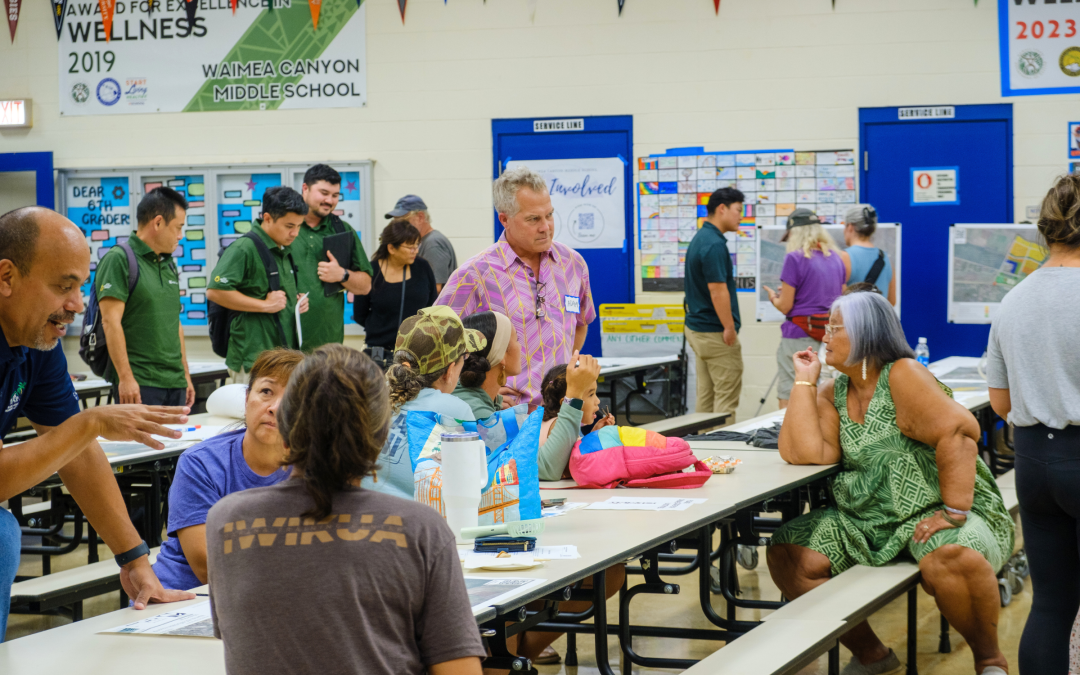
E Ola Kākou Hawai‘i has held seven public community workdays since March in Anahola, Wailua, Kōloa and Līhu‘e. About 20 to 30 participants sift through decaying plant material to see if CRB larvae are present.
CRB breed in mulch, compost, and decomposing stumps or logs and spend about four to six months in those sites. Larvae grow up to three inches before pupating, crawl on their sides and curl into a “C” shape when handled.
Villatora said participants in E Ola Kākou Hawai‘i’s workdays have found and eradicated 166 eggs, 2,539 larvae, 29 pupa, and 114 adults—most were found in Wailua and Kōloa.
Villatora and Cummings added that E Ola Kākou’s community workdays embody ma ka hana ka ‘ike, or to learn by doing. They want participants to become accustomed to identifying CRB.
One informed community member “turns into 10, 10 turns into 100—that’s, I believe, how we community build,” Cummings said. “That’s our kahua (foundation).”

Kaua‘i Nursery & Landscaping now heats its compost piles up to 131 degrees Fahrenheit to kill any larvae that may be in them. The green waste recycling facility takes green waste from the Līhu‘e and Hanapēpē transfer stations, as well as from businesses and members of the general public. | Noelle Fujii-Oride, Overstory
Everybody’s got to try to do a little bit here, a little bit there, because when we get to that point, we might actually get some kind of control over it. Who knows? We’re hoping for the best, obviously, but if nobody wants to chip in and do their part, it’s not going to go anywhere.
Adjusting Practices to Respond to CRB
In Līhu‘e, only a dozen of Kaua‘i Nursery & Landscaping’s palm trees have been damaged by CRB, much to nursery manager Jimmy Toledo’s surprise.
The 100-acre nursery has around 3,000 varieties of plants, of which about 40 are various types of palms. The nursery also operates a green waste recycling facility and has about 10 acres of mulch and compost.
When it comes to treatment, nursery staff have been prioritizing the property’s loulu palms because they’re endemic to Hawai‘i and many varieties are endangered. They use a pesticide tablet that the trees suck up from the soil as they’re watered.
The nursery has also been heating its compost piles—which are about 15 feet tall and 300 to 400 feet long—hotter than normal to 131 degrees Fahrenheit to kill any larvae that may be in them.
In addition to those efforts, the nursery has focused on education. A plastic jar with a handful of dead adult beetles sits on the nursery’s sales counter, so customers can see what they look like. The nursery has also been educating tree trimmers it subcontracts.
“Everybody’s got to try to do a little bit here, a little bit there, because when we get to that point, we might actually get some kind of control over it,” Toledo said. “Who knows? We’re hoping for the best, obviously, but if nobody wants to chip in and do their part, it’s not going to go anywhere.”
Kaleo Chandler of Kaleo’s Tree Services and a few other tree trimmers he knows recognize that they need to act now or else they won’t have palm trees to trim in the future.
During a trim job, he’ll kill any adult beetles he finds and, if the client consents, treat the damaged tree, removing any flowers and coconuts prior to chemical treatments.
“This is enemy number one right now to the tree industry on the island,” he said.
One Kaua‘i farmer Overstory spoke with has started to net his young coconut trees and regularly checks adult trees for damage. He’ll kill any adult beetles he finds, and on some occasions, he’s used small rocks to plug their bore holes. But most of his response has been cleaning up fallen leaves and green waste piles on his farm to find larvae and prevent further breeding.
He spoke with Overstory because he wants more people to know how CRB is impacting farmers like him, but he asked us not to use his name or share his farm’s location, where he also grows mangos, bananas and other fruits, because he’s worried about trespassers.

Nonprofit Conservation Dogs of Hawai‘i is training a group of Kaua‘i-based volunteer CRB detection dog teams. The dogs are being taught to identify the scent of CRB larvae. | Noelle Fujii-Oride, Overstory
Collective, Coordinated Response Needed
Kaua‘i Councilmember Fern Holland has been trying to sound the alarm about CRB’s presence on the island. She serves as the chair of the council’s Parks & Recreation/Transportation Committee.
“We have to pivot to dealing with these beetles for the rest of our lives,” she said. “The faster we do that, the more trees we’ll likely be able to save.”
While the County is not positioned to respond to biosecurity issues, like invasive pests, it has been addressing CRB on its property and supporting other efforts.
The parks department plans to purchase an air curtain burner to burn green waste and mulch piles on County property and in partnership with other government agencies, nonprofits and community groups, Porter wrote.
The County’s Office of Economic Development is administering $200,000 from DOA to create a CRB outreach campaign; support the use of CRB detection dogs and other administrative needs; and distribute deterrent and treatment materials to landscapers, farmers and residents in hotspot areas, wrote Nalani Brun, the department’s director, in an email.
Separately, the County allocated $36,000 to Mālama Kaua‘i, a nonprofit focused on food production and access, to help with green waste management for farmers. OED will also provide $50,000 to Garden Island Resource, Conservation & Development so KISC can acquire and operate a drone for targeted CRB treatment, Brun wrote.
Several community members said that Kaua‘i needs a coordinated, comprehensive and government-backed plan for addressing CRB.
“CRB is a complex challenge and it will take collective effort from government agencies, non-government organizations, and the community working together to support science-based solutions, increased funding, collaboration and information sharing to keep this pest at a controlled level until additional solutions like bio-control are developed and available on Kaua‘i,” Keanini and Chock wrote.
Weiser of CRB Response said UH, HDOA and the state Department of Land and Natural Resources are working to define their roles in the state’s CRB response and create CRB response plans for each of the counties.
CRB Response is primarily funded to manage populations near airports and ports on O‘ahu and around high-risk material being shipped to other islands. It doesn’t have the resources required for eradication on Kaua‘i. Management and treatment for CRB need to be widespread, and that’s difficult to do when an organization doesn’t have the legal authority to track down absentee property owners in infested areas and access their properties for further surveying and potential treatment, he said.
He added that another challenge was that beetles were discovered on Maui in October 2023 and Hawai‘i Island in November 2023, so CRB Response had to be strategic about where it could have the most impact. Back then, beetles were only present in one area on both Maui and Hawai‘i Island, while they were present in multiple areas across Kaua‘i.
HDOA’s capacity has also been limited by understaffing, said Jonathan Ho, Plant Quarantine branch manager at DOA. The department’s Plant Industry division is comprised of the Plant Quarantine, Plant Pest Control and Pesticide branches, and currently has four staff members on Kaua‘i.
Ho said the department is slated to double its Kaua‘i staff thanks to recent funding from the Legislature in the last two years to bolster biosecurity efforts.
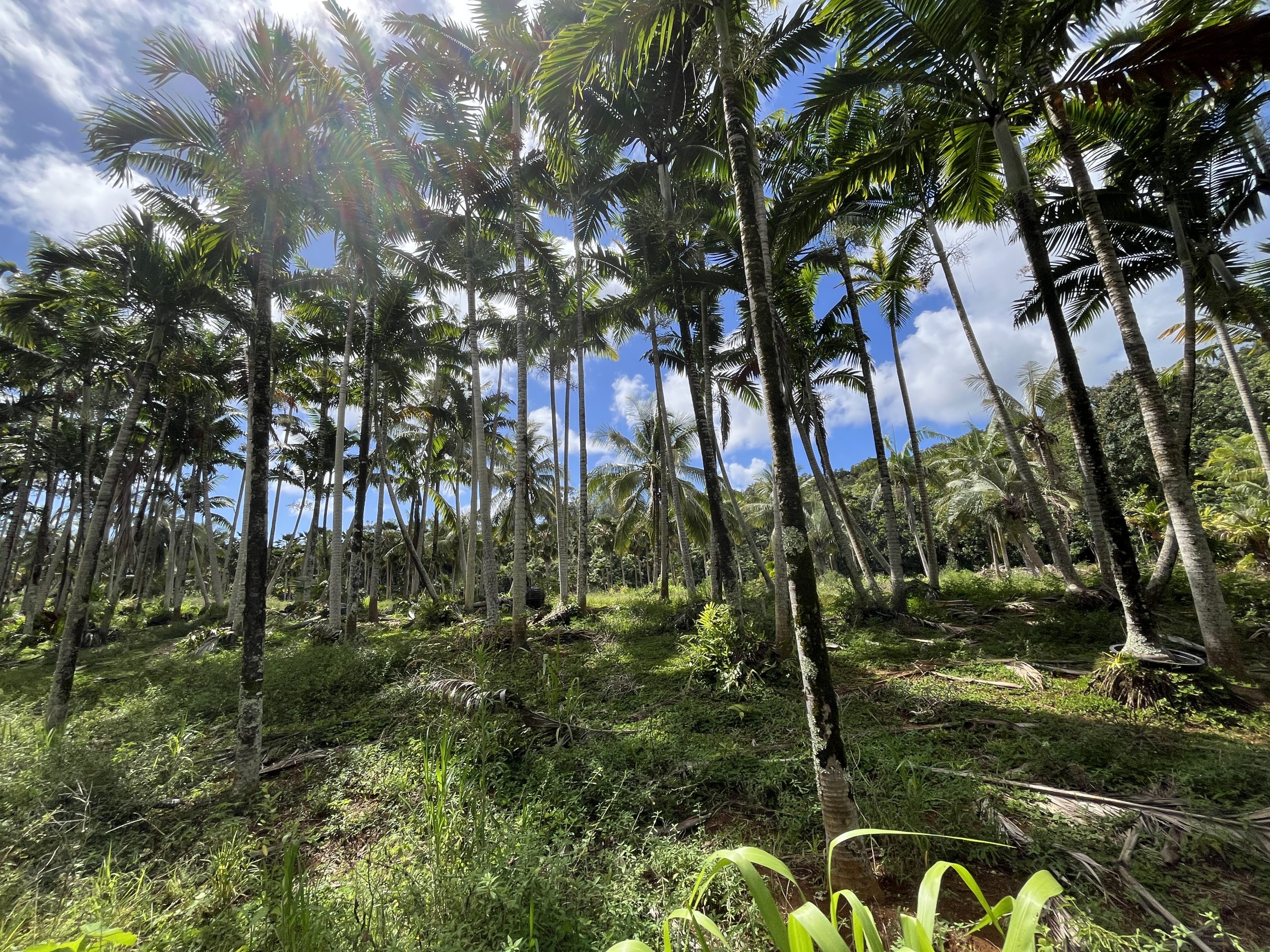
One of the many areas of planted palm trees at Kaua‘i Nursery & Landscaping, which has over 40 varieties of palm trees. | Noelle Fujii-Oride, Overstory
What’s Next
As CRB continues to have an impact on the Garden Isle, several efforts are ramping up to respond.
Funded by a grant from the HDOA, nonprofit ‘Āina Ho‘okupu o Kīlauea plans to help raise awareness among green waste producers and buyers and tree trimmers; map and update existing CRB locations and hotspots on the island’s east and north sides; and provide support for green waste management.
Kaua‘i-based dogs are also being trained by Conservation Dogs of Hawai‘i to detect CRB larvae. Kyoko Johnson, the nonprofit’s founder, said the teams just completed three of its seven-weekend training. CRB larvae are buried in decomposing material, so dogs must be more precise in their sniffing than they would trying to catch a scent in the wind.
“My hope is that they can make a difference in curbing the spread of CRB,” she said. Conservation Dogs of Hawai‘i plans to coordinate field surveys for the detection dog teams after their training is complete.
Villatora compares E Ola Kākou Hawai‘i’s CRB response to the traditional Hawaiian board game of kōnane, where players try to reserve as much resources as possible to outwit and outlast their opponent. In addition to the workdays, she and her partner are training some of their pigs to detect and then eat CRB, a practice that has been used on O‘ahu.
The nonprofit plans to continue its community workdays, though one of the challenges it’s encountered is finding sites where property owners are comfortable having 20 or 30 people participate. The group also doesn’t sift through potential breeding sites that have been treated with chemical pesticides.
Villatora said the group can do private workdays with smaller teams, such as five or 10 people. What matters most is having the extra sets of eyes.
The group is also starting to think more about restoration. Villatora said Native Hawaiians planted coconuts for future generations, rather than the current ones, so some of its community members have been collecting coconut seedlings and sprouting them.
In the meantime, Villatora and Cummings said they encourage community members to join their workdays or address CRB on their own. Villatora said some residents may feel embarrassed for having CRB on their properties, but there’s no reason to.
All community members, she said, need to “come in laulima, in collaboration or cooperation, to get rid of [CRB].”
Correction: A previous version of this story misstated the size of Kaua‘i Nursery & Landscaping’s acreage; this mistake has since been corrected.
Resources for Addressing Coconut Rhinoceros Beetle on Kaua‘i
–Identify the beetle and signs of infestation. Adult beetles are black, horned and about 2 inches in length. Larvae crawl on their side and curl into a “C” shape when handled. Palm damage can include V-shaped cuts or scalloped edges in leaves and 2-inch bore holes in trunks. More information and photos on CRB Response’s website and on the Kaua‘i Office of Economic Development’s website.
–Report beetle sightings: Alert Hawai‘i’s 643Pest Network of new CRB sightings by visiting 643pest.org or by calling 643-PEST (643-7378). Include the date, location and photos.
–Inspect potential CRB breeding sites regularly. CRB like to breed in decomposing material, such as mulch, compost, stumps and logs, dead trees, green waste piles, potting mix, and bagged soil. Larvae can burrow deep, so residents will need to dig through and sift material.
–Treat infected breeding sites and trees: CRB Response’s website includes several treatment methods, ranging from submerging, steaming, burying, netting or tilling breeding material to using pesticides that kill beetles when they eat host trees. (Fruit and flowers should be removed from palm trees before treatment to protect pollinators, and fruit of treated trees cannot be consumed.) Treated sites and trees should be monitored, and additional treatment may be needed.
-CRB green waste management grants: Mālama Kaua‘i, in partnership with the County of Kaua‘i, is providing netting and grants up to $5,000 to help farmers, ranchers and nonprofits manage their green waste at sites where CRB are present. Deadline: June 14, 2025. More information on Mālama Kaua‘i’s website.
–Join a CRB community workday or organize your own. E Ola Kākou Hawai‘i organizes weekend workdays (see their Instagram for updates), and the Kaua‘i Office of Economic Development has a guide to help you organize your area/neighborhood.
–Host a CRB detection trap. Of the 191 traps currently placed around the island, 137 are regularly monitored by community members and partners. Email KISC@hawaii.edu to inquire and see if your property would be a good candidate to host a trap.