Ho‘ākeolapono Trades Academy & Institute
Founded in 2021 on Kaua‘i, Hoʻākeolapono Trades Academy and Institute programs are designed to increase employment and advancement opportunities by providing young adults with crucial knowledge and multidisciplinary, 21st-century trade skills.
American Foundation for Suicide Prevention
Established in 1987, the American Foundation for Suicide Prevention is a voluntary health organization that gives those affected by suicide a nationwide community empowered by research, education and advocacy to take action against this leading cause of death.
Albert C. Kobayashi, Inc.
Albert C. Kobayashi, Inc. has been in operation for more than 55 years, with experience across all construction sectors, from new large-scale, mixed-use high rise buildings to commercial-retail renovation, and nearly everything in between.
Nordic PCL Construction
A general construction company founded in 1938 in Honolulu.
Building Industry Association of Hawai‘i
A not-for-profit trade organization chartered by the National Association of Home Builders in 1955, BIA Hawai‘i has more than 300 professional members across the industry including developers, contractors, suppliers, realtors and associate companies.
Editor’s Note: This article mentions mental health, anxiety, depression and suicide. If you or someone you know may be experiencing a mental health crisis or has thoughts of suicide, contact Hawai‘i CARES 988 by calling or texting 988. The call center is available 24/7.
Kaua‘i resident Lawai‘a Naihe created Ho‘ākeolapono Trades Academy & Institute to prepare the island’s next generation of local construction workers. But having worked as a journeyman carpenter himself for over 20 years, he knew that going beyond construction training would be key to truly setting them up for successful careers and fulfilling lives.
He knows firsthand how despite being a rewarding career, construction is also filled with many stressors, such as pressing deadlines, long and irregular hours, high-pressure environments, lack of job stability and taxing physical labor.
He wanted Ho‘ākeolapono’s interns, who are between 17 and 24 years old, to have the mental fortitude to navigate those challenges in healthy ways, so part of his curriculum focuses on mental wellness.
“Our brain is our biggest, strongest tool,” he said. “If our minds aren’t mentally strong, how can I expect to meet a deadline? How can I expect to do all these things (on a job)?”
His curriculum is especially pertinent as the construction industry nationally faces mental health challenges. Construction nationally has the second-highest suicide rate among major industries, according to the Centers for Disease Control and Prevention. And as an occupation group, construction and extraction has the highest suicide rate among professions.
An analysis is expected to begin soon to see whether suicides in Hawai‘i’s construction industry mirrors national trends. So far, mental health conversations in the local industry have tended to be fragmented, with some companies and organizations encouraging dialogue and offering resources.

About 70 hikers participated in the “Construction Hike for Hope” event on O‘ahu. The June event was hosted by the Hawai‘i chapter of the American Foundation for Suicide Prevention. | Courtesy: Rachelle Chang, AFSP Hawai‘i
Mental Health in Construction
“Stay hopeful! Always!” “You’re not alone! We are in this life together!” “We are always a call away! Don’t give up!” “You matter to me! Prevent suicide.”
On a warm afternoon in June, a little over 70 hikers arrived at the ‘Aiea Loop Trail on O‘ahu carrying “Why I Hike” signs and a banner. They were there for the “Construction Hike for Hope” event to raise awareness about mental health and suicide in the construction industry. The event was hosted by the Hawai‘i chapter of the American Foundation for Suicide Prevention (AFSP).
Rachelle Chang, a board member with AFSP Hawai‘i, said the event was part of a collaborative effort by AFSP and its chapters. The national organization has partnered with construction company Bechtel to prevent construction worker suicides. The two organizations have a $7 million, five-year initiative to reach 500,000 U.S. construction workers through industry-specific programs and resources developed by the two organizations.
In 2022, 5,200 construction workers in the U.S. died by suicide—about five times the number that die from work injuries, according to The Center for Construction Research and Training (also known as CPWR, the acronym for its original name). Construction also has the highest overdose death rate, with 17 times as many overdose deaths as fatal work injuries in 2022, though some suicides are caused by an overdose.
In 2021, 15.4% of U.S. construction workers reported experiencing anxiety or depression, according to CPWR. And 84% of those workers reporting anxiety or depression did not see a mental health professional in the last 12 months.
Research has found that work-related factors contribute to construction workers’ mental wellbeing, according to CPWR. Construction is a fast-paced and high-pressure field as workers must meet constant deadlines, complete their work correctly, engage in strenuous labor and sometimes work in extreme weather. And the cyclical nature of construction jobs sometimes means that work is unstable.
“Because the industry itself depending on the economic climate can be a bit volatile at times, like after the recession in 2009, for many in the industry, they lost jobs or they went out of business,” said Roseann Freitas, CEO of the Building Industry Association (BIA) Hawai‘i, which was a sponsor for the “Construction Hike for Hope” event. “So sometimes because it’s an economical up and down, it can make an impact on people’s ability to make a living.”
Nathan Lutz, the health, safety environment manager at Nordic PCL, said the industry is also challenged by a shortage of workers as more experienced workers retire. That’s forced younger workers to have to learn faster, meet specific deadlines they haven’t had to meet before, and manage crews while also maintaining quality, safety and production standards.
Headquartered in Honolulu, Nordic PCL typically works on 10 to 12 projects at a time across the state. The company currently has about 185 office employees and 140 out on job sites.
The company is not always able to find enough workers already living on some of the neighbor islands, so it will fly O‘ahu workers over. However, if a segment of a project doesn’t go as planned, it can mean longer hours for the crew or spending a weekend day to finish the job.
“That pressure is finishing a product, whether it’s a deck drywall, the overall scope of work to get to the next phase, to the finishing the project on time,” Lutz said. “So that takes overtime, that takes maybe Saturdays, which pulls you away from family.”
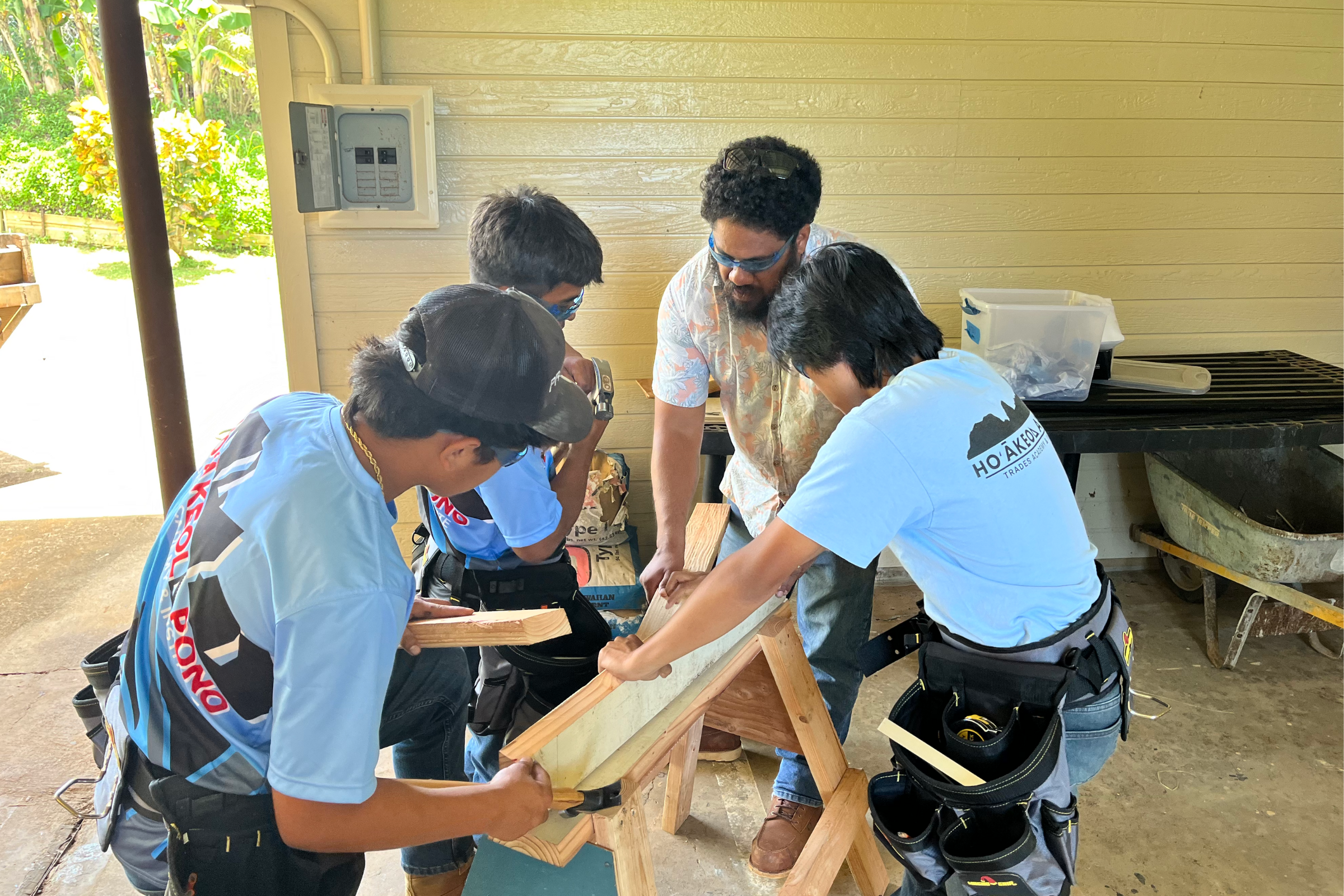
Ho‘ākeolapono Trades Academy & Institute takes a holistic approach to construction education by incorporating mental wellness, as well as financial literacy and physical wellbeing. | Courtesy: Ho‘ākeolapono Trades Academy & Institute
Suicides in Hawai‘i
In Hawai‘i, men made up 76% of the islands’ suicide deaths between 2019 and 2023, said Renee Yu, suicide prevention coordinator for the state Department of Health (DOH). And men in their prime working years—ages 30 to 59—face the highest risk of dying by suicide.
Belinda Danielson, the community programs supervisor of the DOH’s Adult Mental Health Branch, said men have higher rates of suicide because of the means they choose to end their lives.
She and Yu emphasize that suicide is a complex issue and caused by many factors, rather than a single event. The department’s data also demonstrates the importance of creating cultures—at work, at home, across communities—where individuals feel safe to speak up about challenges and check in on one another.
“A man’s man can include not being ok and being ok to talk about your struggles and being vulnerable and being ok to say, ‘hey buddy, you know, I’m here for you,’ ” Danielson said. “Building that culture and breaking down that stigma about mental health and building that support of mental wellbeing, that’s kind of the culture we want to build and kind of the work that that needs to be done.”
Men make up about 88% of Hawai‘i’s construction workforce, according to the state Department of Business, Economic Development and Tourism.
The state DOH is partnering with University of Hawai‘i researchers to examine Hawai‘i suicide rates across various professions, including construction. Those analyses are expected to begin in September.
Mental health hasn’t traditionally been discussed much in the local construction industry, but some said that’s starting to change.
Michael Young, president and CEO of Albert C. Kobayashi (ACK) grew up in the industry and said it was common to see construction crew members keep their heads down if they were stressed or dealing with other problems.
“The difference over the last couple years that I’m seeing is that there’s a little bit of—not enough—but a little bit more attention to the topic and awareness to the point where some individuals are more willing to speak up about it on the job site level, you know, people reference it,” he said.

About 60 students have participated in Ho‘ākeolapono’s internship program so far, with most of them Native Hawaiian. The trades academy currently has interns on Kaua‘i and Hawai‘i Island. | Courtesy: Ho‘ākeolapono Trades Academy & Institute
A Proactive, Preventative Approach
“In the construction realm, we’re a bunch of tough guys,” said Naihe as he sits in the kitchen of an unfinished luxury home in Kukui‘ula on Kaua‘i’s south side. “We don’t talk about our emotions; we don’t talk about our feelings.”
Warning Signs of Suicide or Other Mental Health Concerns
Suicide is complex and caused by many factors. Knowing the possible warning signs can help save a life. These are some of them:
- Loss of interest in activities or a lack of motivation
- Withdrawing from others
- Talking about being a burden or that the world is better off without them
- Trouble concentrating
- Trouble sleeping
- Feeling tense, nervous or anxious
- Frequent mood swings
These signs can also point to someone experiencing anxiety, depression or another mental health challenge. While not everyone experiencing a meant health challenge will attempt suicide, it’s best to check in with the person showing behavior changes and ask if they’re thinking about harming themself.
Asking the question is not going to plant the idea in their head, said Belinda Danielson, the community programs supervisor with the state DOH’s Adult Mental Health Branch.
“The risk is that it was suicide, and we missed it,” she said. “So for us if there’s a change of behavior, think that it’s suicide, ask the question.”
Sources: How to Help in Crisis Situations by the National Association of Homebuilders and Mindwise, Warning Signs of Suicide Toolbox Talk by Construction Suicide Prevention Week
The sound of hammers and drills echoes as Ho‘ākeolapono interns and crew members work alongside other subcontractors. They recently installed a floating staircase and custom cabinets and created vaulted tray ceilings.
“However, I think that that’s a very ignorant way to look at yourself because we need to be able to understand ourselves holistically,” Naihe added.
That’s why Ho‘ākeolapono takes a holistic approach to construction education by incorporating mental wellness, as well as financial literacy and physical wellbeing.
“We really want to take the holistic approach to construction because it’s so overlooked,” Naihe said. “It’s like ‘Oh, those guys just going to be construction workers, they don’t need to know anything about finances.’ Or ‘they’re just going to be digging holes, what do they need counseling or mental wellness for?’ ”
Kaua‘i psychologist Dr. Alex Bivens created Ho‘ākeolapono’s six-module mental wellness curriculum a little over a year ago, and it’s meant to take a proactive, prevention-oriented approach.
His two-hour seminars focus on topics like resilience; how physical health, relationships and productivity set the foundation for mental wellness; the mindsets, attitudes and behavior patterns of effective people; work ethic; and getting in touch with one’s identity and core values.
“We thought we would acquaint these guys with their own capacity for resilience, and we’re tying this in with concepts that we thought would play well, like, in other words, there’s a relationship between resilience and other desirable qualities like strength, perseverance, long term success, and kind of creating that as a foundational framework,” he said.
The curriculum was designed as a skill-building model to align with the construction industry. As a result, he said he’s received positive responses from the interns, who often ask him questions so they can apply what they’re learning to their own life situations. For example, some have asked how they can maintain good relationships with their parents as young adults living on their own.
“Everyone has their own experiences,” Naihe said. “We can’t tell them, ‘This is how you’re supposed to feel.’ We need them to understand why we are feeling this way because then it’s ok, then we know. When I don’t understand what’s going on, it’s chaotic, and once you understand yourself, life is so much more fun.”
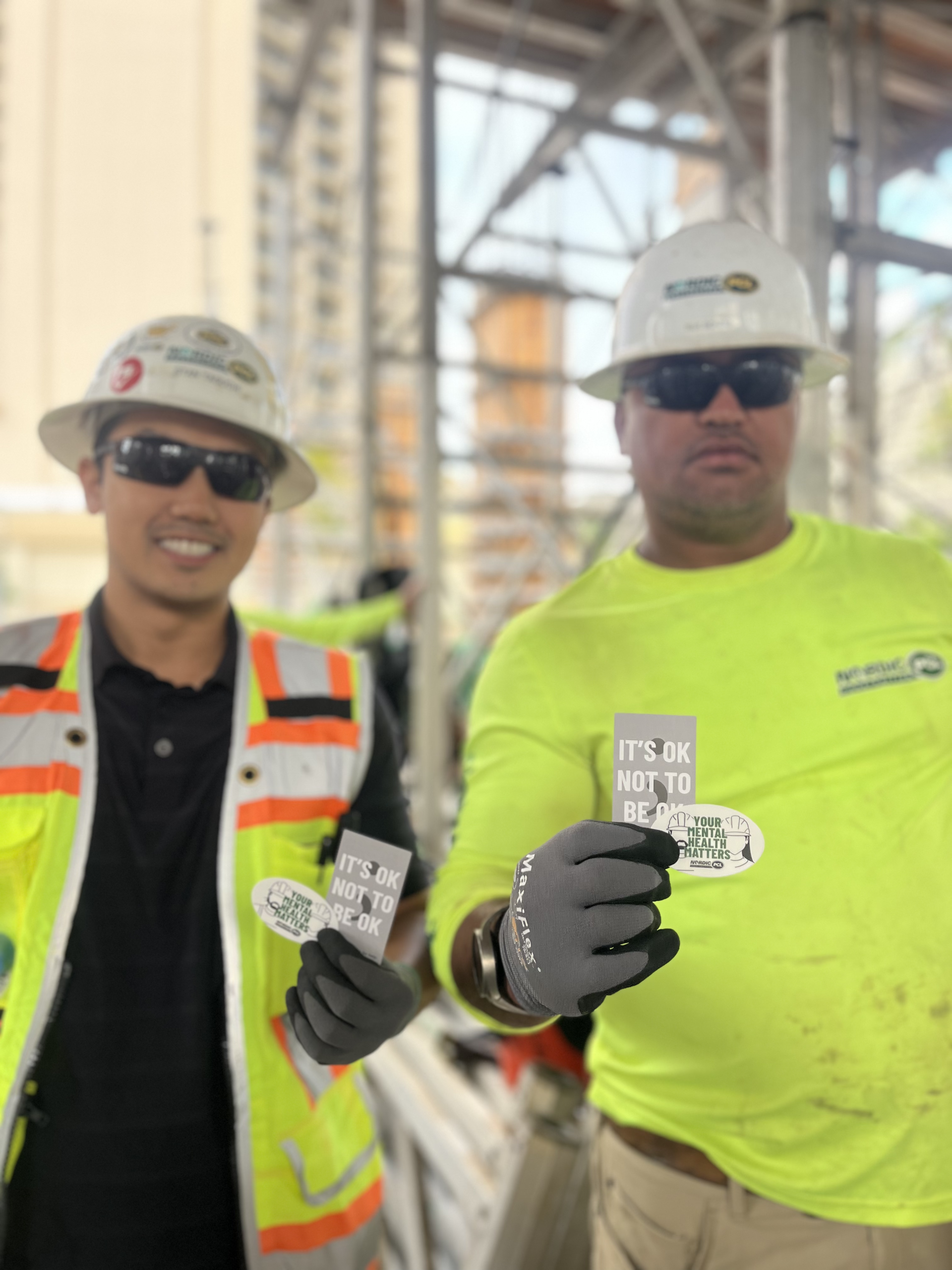
Nordic PCL employees hold up stickers that the company created to raise awareness about mental health. The company will be participating in the national Construction Suicide Prevention Stand-down on Sept. 8 to honor those who have been loss to suicides and re-commit to preventing future losses. | Courtesy: Nordic PCL
Awareness Vs. Resources
Some local construction companies incorporate mental health resources and education into their annual Construction Safety Weeks in May and into their overall workplace cultures.
ACK has about 100 office employees and another 200 working at its various job sites. For this year’s safety week, ACK shut down its job sites for a day and conducted a three-hour training on physical safety and mental health. Young said this was possible because all ACK’s construction workers at the time were on O‘ahu, rather than spread across islands.
Young added that he tries to instill a workplace culture of openness and trust as the company’s leader.
“Communication, trust, taking care of each other, respect, all these traits are important, not that they weren’t important before, but they’re important to me,” he said. “And I think along with that, comes with an understanding, a recognition of, if somebody is stressed out, that it’s okay to be stressed out, and we should address it, not dismiss it.”
Lutz said Nordic PCL has been raising awareness about mental health and suicide prevention since 2022. A former health, safety and environment employee had lost someone to suicide and made hard hat decals, stickers, pamphlets and other materials to encourage awareness.
Each Nordic PCL job site also has a Linktree where crew members can access mental health resources, such as the 988 suicide helpline, how to contact a crisis counselor, the Construction Industry Alliance for Suicide Prevention and Project Semicolon. Nordic PCL’s parent company, PCL, also provides employees access to Lyra Health’s mental health services.
“What I love about Nordic PCL, we’re so family oriented,” Lutz said. “If you see a worker that doesn’t look right, we’re grab him or her and say is everything alright? If they they’re all right, okay, let’s go on, but we’ll watch it. If they’re not, we’ll get whatever we need for them taken care of.”
But mental health hasn’t yet become a widely recognized concern across the local construction industry.
On Maui, Mike Young is the owner of Wide Open Construction and the apprenticeship program coordinator at the University of Hawai‘i Maui College’s Office of Extended Learning and Workforce Development. He said he didn’t realize that mental health was a concern in the local industry, or that the industry nationally has a high suicide rate, until Overstory called him.
His crew of 15 employees, along with several teams of subcontractors, is working on 30-something jobs, mostly in Lahaina. His company now runs seven days a week, though his employees work different shifts. Some work Monday to Friday, while others, who have full-time jobs elsewhere, come and work the weekends with him.
He said he’s seen a lot of dedication from his team as they help to rebuild Lahaina. One of the jobs is rebuilding his own house, which he lost in the August 2023 wildfire, on the weekends. While he said his business is keeping him busy, he said it’s not the biggest stressor on his plate. Rather, it’s moving from temporary home to temporary home until his house is rebuilt.
“This is right now probably the hardest part,” he said. “I’m always running 10 jobs at a time, I’m full time at UH, but the hardest part for me right now is finding one roof for my family right now.”
He tries to take everything day-by-day and added that more mental health support would be beneficial for construction, as well as any high-stress industry. He especially thinks it would help those in management positions, such as foremen and construction business owners.
Overstory also reached out to a couple of other Maui construction businesses to inquire about mental health support amid the ongoing rebuilding in Lahaina, but they were not available for interviews.
More Mental Health Conversations, Awareness Needed
On Sept. 8, Nordic PCL will participate in the national Construction Suicide Prevention Stand-down to honor those who have been loss and re-commit to preventing future suicides.
“As a district, we are asking for full participation across every project,” Lutz wrote in an email to Nordic PCL staff. “Suicide prevention is not simply an HSE (health, safety, environment) or HR responsibility; it is a human responsibility. This gives us the opportunity to have open conversations, break down stigmas, and reinforce that seeking help is a sign of strength, not weakness.”
Construction has been stable in Hawai‘i and is expected to remain busy with major projects like the $10 billion Honolulu Skyline rail system, the $550 million Kapālama Container Terminal, $3.5 billion Pearl Harbor dry dock, $400 million Aloha Stadium district and the rebuilding of Lahaina, and various resort, housing and school projects.
Lutz and ACK’s Michael Young said they worry that mental health in the industry may get worse as projects get bigger, already-busy schedules get tighter, fewer people enter the field and more workers retire.
“I think that the consequences of that besides, obviously, the quality of work and other things is going to be stress on the existing workforce to have to cover and shoulder the load of more demand for construction and without, you know, the proper supply of workers, without the proper support for those workers,” said ACK’s Young.
He and Lutz said they want to see more local companies and the local professional associations, like the General Contractors Association Hawai‘i (GCA) and BIA Hawai‘i further prioritize and support workers’ mental health. Their national parent organizations, the National Association of Home Builders and the Associated General Contractors of America, have prioritized mental health and suicide prevention for several years.
“In order to make a difference on that community level, we need enough companies to be champions and leaders,” ACK’s Young said. “And then within those companies, you need those individuals who are passionate about this and are championing and pushing.”
Freitas of BIA Hawai‘i, agrees that more awareness is needed. The organization is talking with a continent-based company about an app-based technology that can help construction supervisors identify when employees are having an off-day and may not be fit to go into the field.
Employees would take an app-based test that gauges how well and quickly they complete certain patterns. While the technology was developed from a physical safety standpoint, Freitas thinks it could help employers better support their workers’ mental health.
GCA Hawai‘i did not respond to multiple interview requests for this article.
Naihe of Kaua‘i’s Ho‘ākeolapono said the difficult thing about seeing meaningful industry shifts to support workers’ mental health is that it costs money.
“When do we get these guys to go to mental health training?” he asked. “On my time, when they’re supposed to be building this house? On their own time, when they have to go and do these things and they got to deal with their family and things like that?”
Where to Find Help and Resources
Resources are available to help if you or someone you know is experiencing a really low point.
- How to Help in Crisis Situations: A short guide on warning signs that someone may be experiencing mental health struggles, how you can respond and why it’s important to get help prepared by the National Association of Homebuilders and Mindwise.
- Toolbox Talk on Mental Health and Substance Misuse in Construction: A short guide on how the construction industry is impacted by mental health and substance misuse, plus tips to discuss mental health prepared by the National Association of Homebuilders and Mindwise.
- Construction Suicide Prevention Week Toolbox Talks: Available in English and Spanish, they include the warning signs of suicide, how you can help reduce stigma around mental illness, how to engage in active listening, lethal means safety, coping with suicide loss and more. Construction Suicide Prevention Week has been held annually since 2020 to help raise awareness about suicides in the industry and provide resources to prevent them. This year’s Construction Suicide Prevention Week will take place on Sept. 8 to 12. (Another construction-focused group is the Construction Industry Alliance for Suicide Prevention, which was created in 2016.)
- Learn how to recognize when someone is experiencing mental health challenges and needs help. The American Foundation for Suicide Prevention’s Hawai‘i chapter, Mental Health America of Hawai‘i, the National Alliance on Mental Illness Hawai‘i chapter and the Military and Family Support Center offer mental health education and suicide prevention classes and other resources.
- Hawai‘i CARES 988 Call Center: Call, text or chat 988. Available 24/7 and to anyone in Hawai‘i, locally trained staff on O‘ahu provide supportive counseling and screening for urgent or emergent mental health or substance use needs, recommendations for behavioral health assessments, services, and crisis interventions. The call center can also send a crisis mobile outreach worker to meet with you face-to-face on any island within an hour.
- Hawaii Poison Center: provides help for poisoning emergencies. Call 1-800-222-1222. Help is available 24 hours a day, seven days a week.