
Brain Health Applied Research Institute
A nonprofit that translates scientific research into programs and solutions that support brain health.

I-ON Group
A design and development company committed to fostering a more sustainable coexistence between the built and natural environments.

The Institute for Human Services
A private non-profit organization focused on creating and offering tailored solutions for those in crisis as well as nurturing homeless people toward greater self-direction and responsibility.

Mental Health Kōkua
A nonprofit that aims to passionately assist people with behavioral health and related challenges to achieve optimum functioning, quality of life, and integration in their communities.
A door with a lock and key. A mailbox to receive handwritten notes from neighbors. Space to organize one’s belongings. A dedicated entry area to talk story with neighbors.
These may not seem like anything out of the ordinary, but for individuals who have experienced houselessness and live with cognitive impairment, they are steps to regaining one’s sense of security and self-worth and re-building communication skills.
That’s the basis for the Kumu Ola Hou Iwilei Transitional Shelter, where housing units and daily activities are intentionally designed to encourage neuroplasticity and help individuals relearn essential life skills and habits that are often lost due to the instability and trauma of homelessness.
Neuroplasticity is the brain’s ability to adapt by creating new neurons and networks. This enables individuals to develop new mindsets, learn new skills, form new memories and change dysfunctional thought and behavioral patterns.
“I always say the house is a teacher and all it’s trying to do is to re-teach you the daily life habits that you lost,” said Ma Ry Kim, an architect and co-founder of the Brain Health Applied Research Institute (B+HARI), a nonprofit that translates scientific research into programs and solutions that support brain health.
B+HARI designed the shelter, contributing its expertise in neuroscience-backed design, in collaboration with I-ON Group, a design and development firm that also served as the architect.
Kim calls the combination of neuroscience and intentional architecture and programming to support healing and recovery “compassionate housing.”
“It’s hard to put into words, but when you’re here, … you can see humanity happening,” she said.
Located in Iwilei Center, Kumu Ola Hou opened in March and has capacity for 24 residents. The facility is a collaboration between the City and County of Honolulu, which owns Iwilei Center, and the state, which is funding The Institute for Human Services (IHS) to manage it.

Each of the design elements in the above graphic is meant to help guests of Kumu Ola Hou relearn essential life skills and daily habits. | Courtesy: B+HARI
Compassionate Housing
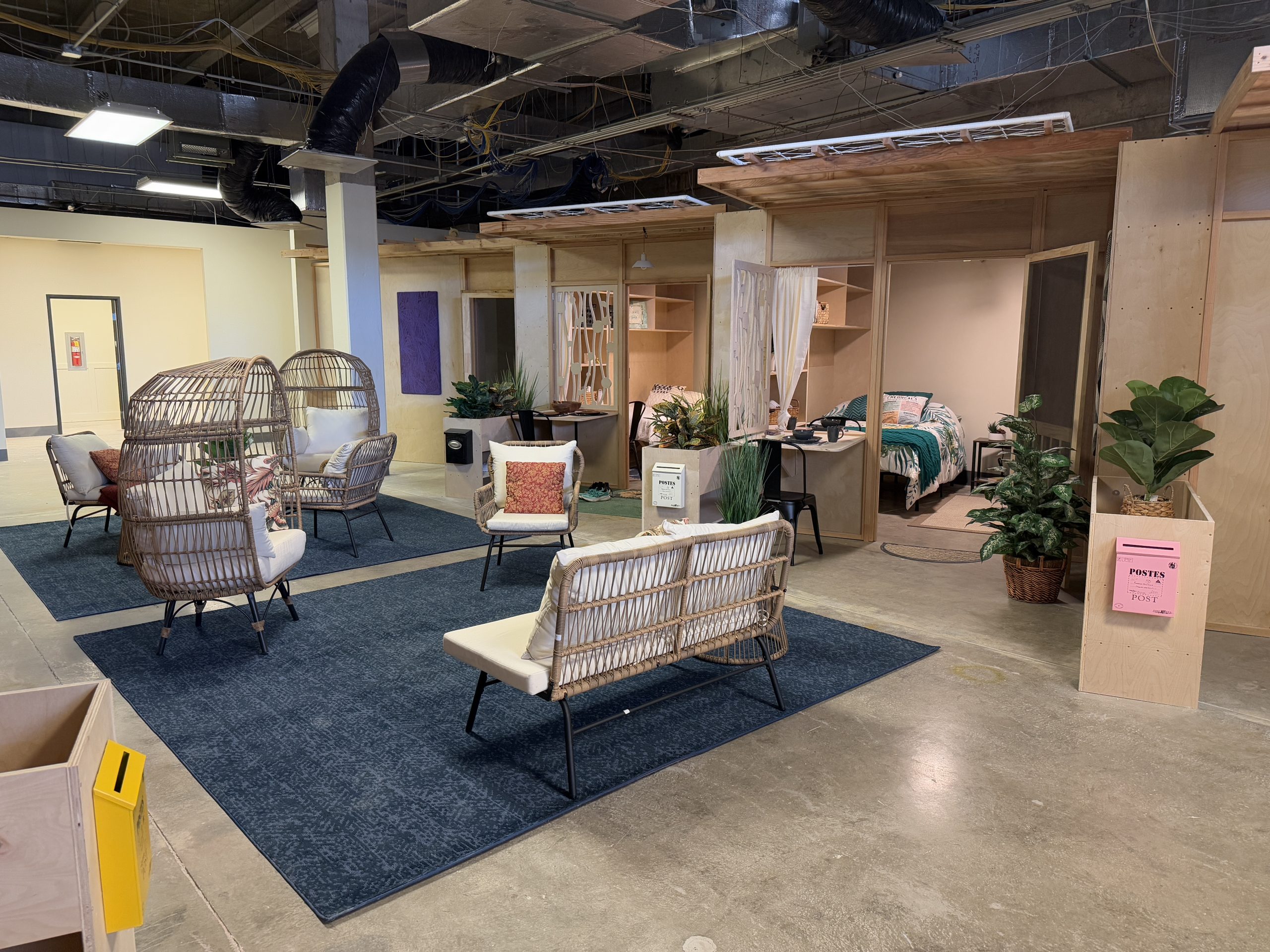
Kumu Ola Hou is located on the ground floor of a warehouse, but its design intentionally invokes the feeling of walking along a neighborhood street in Hawai‘i. Made from unfinished wood and situated around a communal living room, the 13 housing units are oriented towards the warehouse’s windows. Each unit has a front lānai with a shoe rack, garden box, mailbox and entry bench.
Inside are wall shelves, a closet and an overhead trellis. The trellis helps disperse the warehouse’s florescent lights and provides a space for guests to hang plants, additional lights and laundry.
The design elements are paired with a set of 12 activity cards with Native Hawaiian values and principles that are tied to brain health. One card focuses on kuleana—taking responsibility. Guests can do that by taking care of their housing units and the facility’s communal areas. Each unit has a gardening box and cleaning kit for that purpose, and the activity strengthens the prefrontal cortex, which is responsible for impulsivity control, planning and making socially appropriate decisions.
“A lot of times when people are asked to run shelters, you’re asked to just shelter the people until we can get them into housing, but what we’re looking at is really helping them to heal, helping them to find their strengths, and then we can move forward just a lot stronger and have much more success when they go into housing,” said Connie Mitchell, executive director of IHS. She helped B+HARI identify the 12 daily life skills and habits that are eroded by homelessness.
Another card focuses on meiwi, which are traditional elements of Hawaiian poetry and storytelling. For Kumu Ola Hou guests, it’s meant to encourage them to talk story with others and build their communication skills, and each housing unit’s dedicated entry area is designed for that activity. Communication strengthens the Broca’s and Wernicke’s areas and the angular and supramarginal gyri in the brain.
Kim said Kumu Ola Hou was designed using the findings of the McCance Center for Brain Health’s Brain Care Score, which found that chronic stress, lack of social engagement and a lack of purpose in life are among 17 risk factors of stroke, dementia and late-life depression. Constant stress caused by homelessness can increase inflammation in the brain, which then can worsen memory and hinder the brain’s capacity for neuroplasticity, said Dr. Kazuma Nakagawa, a neurologist and co-founder of B+HARI.
The McCance Center at Massachusetts General Hospital and Harvard is the founder of the Global Brain Care Coalition, which aims to reduce new cases of dementia, stroke and depression by 10% in the next decade and by 30% by 2050. B+HARI is a member of that coalition.

The housing units were made with unfinished wood to evoke feelings of being close to nature. | Courtesy: B+HARI
A Focus on Healing
The facility targets individuals experiencing homelessness and living with substance abuse disorders, mental health conditions, brain injuries and memory challenges.
Timothy Johnson, who runs the shelter, calls those who stay there “guests,” rather than “residents” to emphasize the temporary nature of their stays, which are expected to be about three months, though it’ll vary based on the individual.
He said his job is to listen, observe and validate guests’ efforts. He recalled one guest who completed eight card tasks in one day but still didn’t feel like she was doing enough. He reassured her that she was doing great and needed to pace herself.
In addition to coaching guests through the 12 activity cards, he and his team hold various group activities, such as dancing, hope journaling, cooking, music therapy, yoga and art.
“They all go hand in hand,” Mitchell said. “All activities like yoga, cooking, journaling, dancing have some neuroplasticity benefit in the way it is conducted as indicated on the Ho‘okipa (activity) cards. And the other things like a safe personal space that promotes security and trauma healing, a comfortable bed to promote sleep that helps with recovery and the social spaces created by the arrangement of furnishings all intentionally move participants in a particular direction of healing.”
How guests interact with the facility’s housing units can help IHS staff gauge their progress. For example, when guests first arrived, they closed and locked their doors. But after a few days, they left their doors open. Kim said it shows guests are regaining their sense of trust.
A unit’s entry can also yield insights. From inside the unit, a guest can open his or her window and speak with another person who is on the lānai. Or a guest could join the other person on the lānai or pull down the foldable table under the window to sit around. Having a closed window all the time tells IHS staff that a guest isn’t making progress with building connections with others.
“The house is always supposed to tell the story,” Kim said.
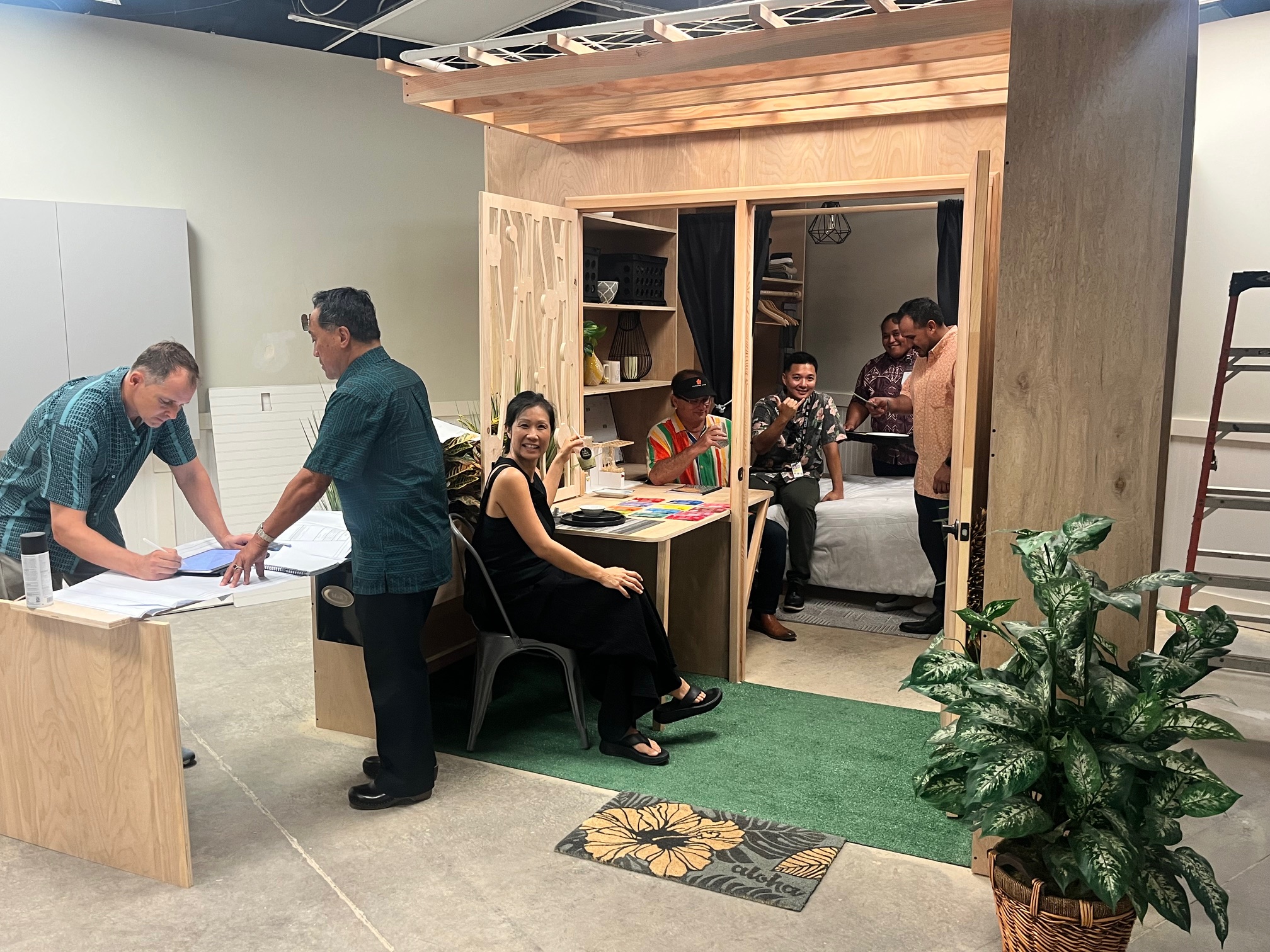
The facility was designed by two organizations: B+HARI, contributing its expertise in neuroscience-backed design, in collaboration with I-ON Group, a design and development firm that also served as the architect. Ma Ry Kim, an architect and co-founder of B+HARI, said Kumu Ola Hou was designed for local skillsets and built using a local crew and readily available materials. She said this kept costs low but also ensured that money stayed in local pockets. | Courtesy: B+HARI
Looking Ahead
Kumu Ola Hou was built knowing that its location at Iwilei Center is temporary, so its housing units are made of four modular, furniture-like components that can be easily taken apart and moved. The City and County of Honolulu purchased the warehouse in 2024 to convert it into housing. It’s part of a large-scale transit-oriented plan for the area surrounding the Iwilei-Kūwili Skyline station, with ground-breaking expected in 2028.
Anton Krucky, director of the City’s Department of Community Services, said he’s impressed by Kumu Ola Hou’s combination of architecture, brain science and behavioral health. He was one of the project’s early supporters, and his department provided funding for the facility’s construction and design.
“I have no lack of confidence that this will be successful,” he said, adding that each of Kumu Ola Hou’s units is being delivered for about $11,000 a year. By comparison, it’s estimated that emergency room care for a person living with homelessness costs about $82,000 on average per year.
Three additional shelters will join Kumu Ola Hou in Iwilei Center. The total number of beds across all four shelters will be about 100. Kim said the compassionate housing model will be used in the three new shelters, though the design of their facilities will be tailored to the specific needs of each shelter’s target population.
Two will be managed by Mental Health Kōkua, which assists individuals experiencing behavioral health challenges. IHS will manage the third shelter, which will target employed men. Mitchell said the IHS program will focus on helping guests learn life hacks that may have been forgotten, financial literacy, and coping strategies to avoid relapsing into unhealthy behaviors and choices.
Kumu Ola Hou had only been open for just under a month when Overstory visited the facility. Johnson and Mitchell said they were expecting a guest to move on from the shelter in the coming weeks.
IHS will consider discharge when a guest has demonstrated that their mental health and cognitive function have stabilized and when they show they can carry on in a way that will enable them to remain housed, Mitchell said. Some guests will be discharged to independent living with supports, while others may be discharged into another group living situation or back home with their families.
“Our goal is always to help an individual improve their basic function in life by establishing routines and ensure that they are linked with necessary services and any medication management to support stability,” she said.
Johnson added that he hopes each of Kumu Ola Hou’s guests feel understood and know that it’s OK to be themselves: “People leaving with confidence and a sense of belonging knowing that it’s OK to be different. It’s okay to be different, and if anything, their differences make them outstanding.”